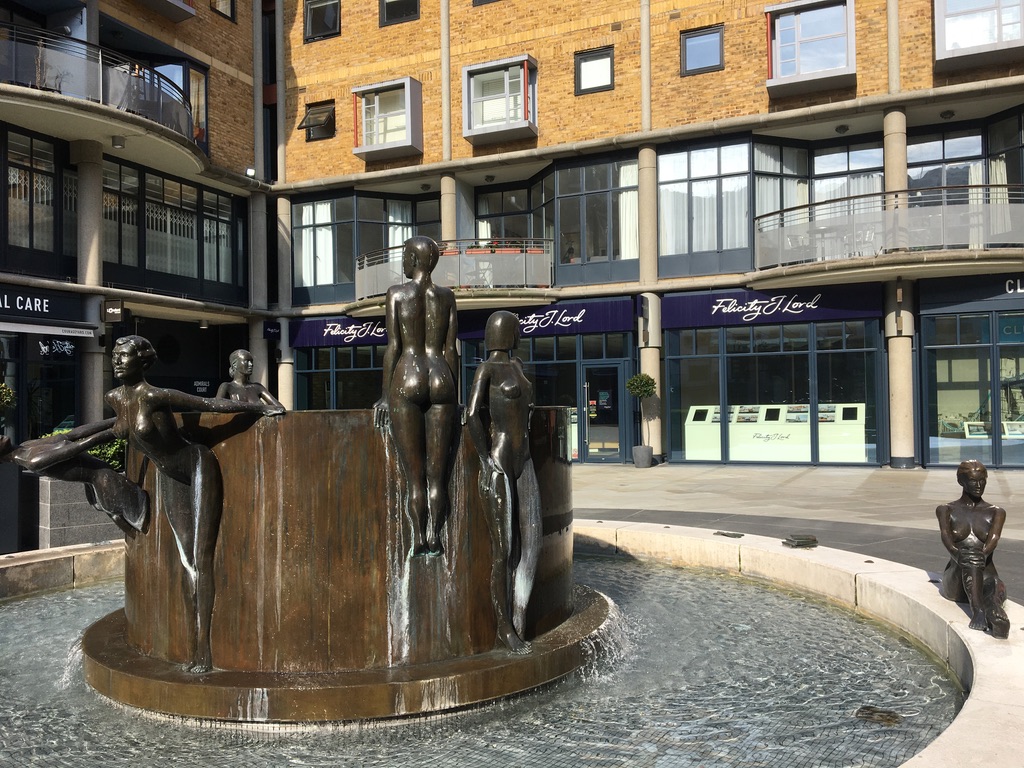
THE fountain below my window features a group of seemingly timeless naked bronze water nymphs relaxing around a pond.
Timeless, until you take a closer look at the objects they placed at the pond’s edge while they took their dip. There’s a bronze harmonica, a cassette player, a camera and a pile of books, even a box of paints and brushes. What? No smart phone, or iPad or wireless earbuds?
Antony Donaldson’s sculpture, put there in 1991, is just so 20th century! The Pop Art era artist’s predilection for portraying youthful, sexually confident women striking flirtatious poses also seems to belong to a bygone age – unless you count Instagram.
Donaldson’s work is evidence that life unfolds in tiny increments, which is hard to recall at a time when our lives seem to have changed overnight.
There was no single day on which cassette players disappeared or mouth organs and water colours went out of fashion. But in the less than 30 years since Donaldson created his fountain, our lives have been transformed by technology and the poolside scene now looks almost as quaint as a Victorian oil painting.
A younger generation marvels at how people survived past pandemics without broadband, Zoom and permanent contact with absent friends via Facebook and Twitter. In those days, there would have been no broadcasting from the kitchen table for either TV anchors or their interviewees.
There have been other changes in the intervening years. Round the corner they built City Hall, where Boris Johnson lorded it as mayor before he became prime minister, further proof that progress doesn’t necessarily travel in a straight line.
The old wino pubs in nearby Tooley Street were shut down or transformed as the developers cashed in on riverside London in a former industrial part of town.
A bunch of chancers took over the freehold of our block a few years back before selling out to Southwark Council at a profit. I forget their name but it ended in “Jersey LLP”, never a good sign.
They almost trashed the place during their short tenure, changing the colour scheme, extending the elegant columned shopfronts by architects Wickham van Eyck, and building a white elephant pavilion next to the fountain.
They also renamed the development from the ritzy 90s’ Tower Bridge Piazza to the more solid Courage Yard, after the Courage Brewery that previously occupied the site.
They wanted to move the nymphs and the fountain to a more obscure corner but faced a rebellion by tenants and leaseholders that saw off that particular threat.
The ugly glass pavilion has been occupied pro tem by Zoopla, the real estate tracking company that is headquartered off the square. I assume the 400 staff have been sent home where they continue to beaver away on that vital house price sector.
“The closure of estate agency branches and general uncertainty has resulted in far fewer sales agreed in the last two weeks, with less new supply coming to the market,” its research director lamented last week.
But, eager to prove that every cloud has a silver lining, Zoopla later recorded a 215 per cent increase in potential buyers viewing new-build homes virtually. Customers view the home on a mobile phone or computer from various vantage points and can click for more information. Apparently remote rich foreign buyers have been using the system for years.
Personally, I think it would be no bad thing if prices came down a bit as the economy slows down. I moved in at the height of the the property crash of the early 90s’, otherwise I wouldn’t be writing this next to the nymphs right now.
 Idle Thoughts on London Walks