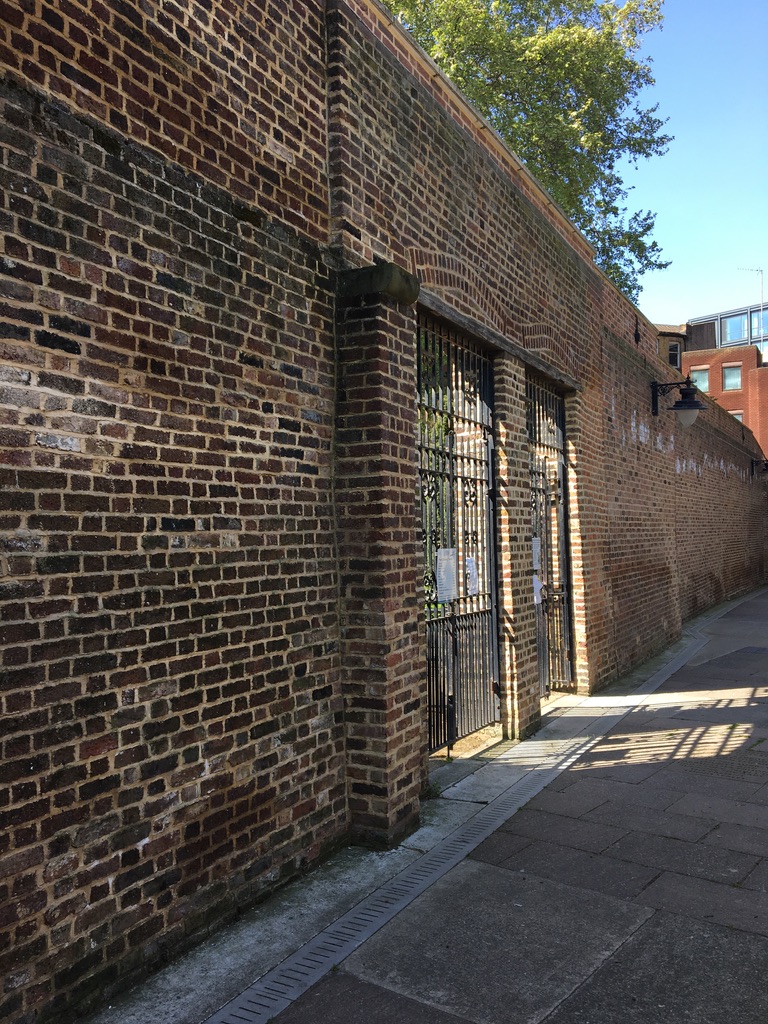
THE Marshalsea.
Even the name sounds sinister, a hint of stagnant shoreline or a half-forgotten memory of Dickensian distress.
The name of what was London’s most notorious prison for 500 years from the 14th century comes, though, from the Anglo-French mareschalcie, the seat of courts and tribunals in Medieval Europe.
The jail was immortalised in three of Charles Dickens’ novels, most notably in Little Dorrit, whose heroine is born there. The author’s father had been confined to the Marshalsea when it had become principally a debtors’ prison.
The routine torture of inmates had been abandoned by then. But it was still a fetid, crowded place, even if there was beer on tap for those who could rustle up a few coppers.
Debtors they might have been, but they were required to pay rent.
It struck me as an appropriate spot to escape briefly the confinement of lockdown London. Only one wall, with a Historic Southwark plaque, remains from the prison compound that was finally shut down in 1842. Tucked away in a narrow alley off the Borough, you could blink and miss it.
Today, there were just two homeless men lounging in the small churchyard nearby, one chugging on a family-size plastic bottle of some indeterminate liquor.
Much as I love London, there is a dark streak at the heart of its psychogeography, from the remnants of the Malshalsea, to Newgate and the Bloody Tower.
And what other city would boast among its top visitor attractions an equivalent of the Jack the Ripper tours that follow the trail of the unknown serial killer who eviscerated his women victims around Whitechapel.
Not far from the Marshalsea is the Clink, the site of another prison, dating from the 12th century, whose name entered the London vernacular, as in: “Ain’t seen Bill lately.” “He’s in clink.”
The old warehouse that replaced the jail is now the Clink Museum, a long-running tourist attraction dedicated to torture and imprisonment. There is even a mouldering skeleton in an iron cage above the door.
Then there is the pub at Tower Hill, once a regular spot for executions. The Hung, Drawn and Quartered has a sign outside on which the words of the 17th century diarist, Samuel Pepys, celebrate one of those who died there.
“I went to see Major General Harrison hung drawn and quartered,” Pepys wrote. “He was looking as cheerful as any man could in that condition.”
Another tourist venue, the London Dungeon, a kitsch compendium of fake blood and gore, has mercifully been shut down by the pandemic.
And then there’s Scotland Yard’s Black Museum, and the pathology museum at Guy’s Hospital, where some exhibits are so gross only registered medics are allowed to see them.
Now, don’t let me put you off visiting London. There’s plenty of other more cheerful stuff. But, beware a dark night down by the river, or getting lost in some back street in the East End, or straying into Angel Lane towards remnants of the Marshalsea…
The London Museum has a gallery dedicated to War, Plague and Fire. Let’s just hope they don’t add a coronavirus wing.
 Idle Thoughts on London Walks