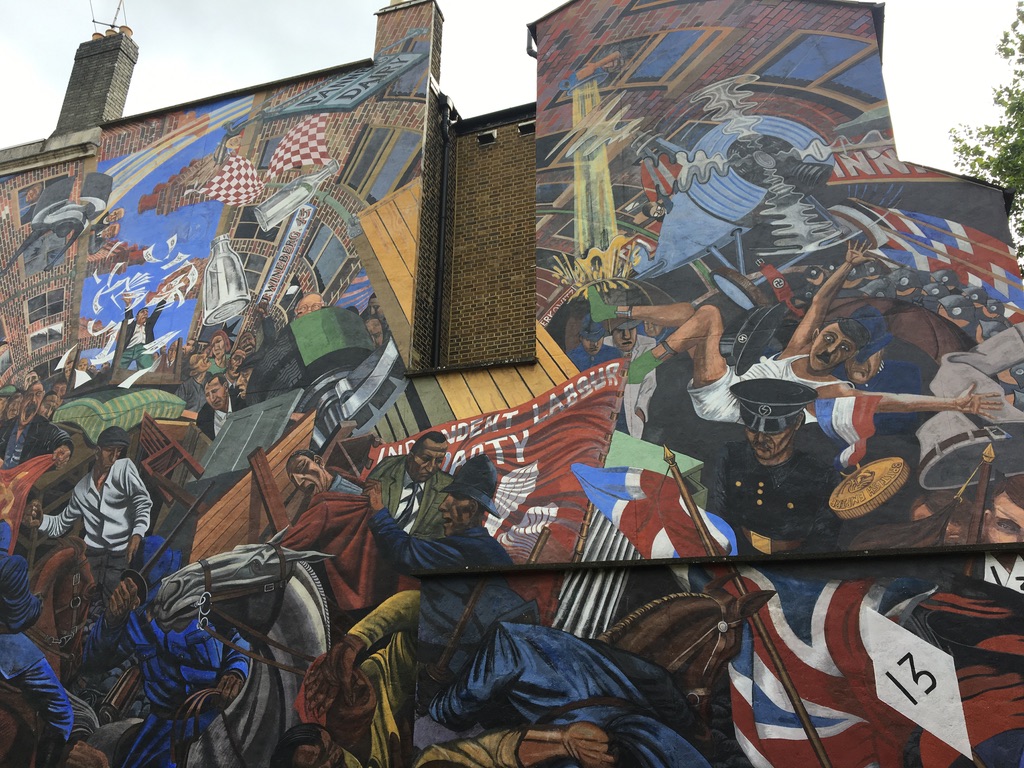
CABLE STREET is on the edge of the once very working class and very Jewish East End, site of a memorable battle in which fascism was defeated three years before the outbreak of World War II.
The Battle of Cable Street pitted an alliance of locals, workers, Socialists and Jews – some would have ticked all four boxes – against the British Union of Fascists, a rag-tag army of fanatics and thugs led by Oswald Mosley.
They were an army only in the sense that they got to dress up. It was collarless black shirts for the rank and file, with the addition of riding britches, jackboots and peaked caps for Sir Oswald and his officers.
Most of the fighting on that October day was between the anti-fascists and the police, who had been sent in to protect Mosley’s blackshirts. The government had rejected a petition by locals to ban them from marching through the East End.
Some 20,000 anti-fascists manned barricades and used sticks, bottles, rocks and even rotten vegetables to block around 6,000 police and the 2,000 or so blackshirts sheltering behind them.
Mosley eventually abandoned his march, ostensibly to prevent further bloodshed. That doesn’t sound very übermenschlich, does it?
It was a technical knockout in favour of the anti-fascists. But the brilliant killer blow came in the following month, November 1936, when parliament outlawed the wearing of uniforms by political groups in response to the Cable Street battle.
It knocked the stuffing out of Mosley’s movement. After all, half the attraction of fascism is presumably the uniform. The movement went into decline from its peak of 50,000 members and was banned in 1940 after the war had already started. Mosley was interned.
There’s anecdotal evidence that some who donned the black shirt weren’t even political. In one confrontation, my friend’s docker father ran up against a workmate who was wearing the full black kit plus a thick belt lined with razor blades. “What the fuck you doin’ ‘ere?” says docker Harry as he aims a punch. “Cos they pay good money, pal!” says the other.
The Public Order Bill 1936 went through Parliament with little opposition. But even some who voted for it were uneasy. Lord Snell echoed the unease of many when he told the upper house: “It may mark the beginning of the end of our dearly cherished political liberties.”
The overwhelming view, however, was that fascism and its uniforms were disagreeable foreign imports that Britain could well do without.
The overall message from Parliament was that Mosley and his thugs could not argue that they had the freedom to do what they liked, including wear paramilitary uniforms, if their main purpose was to stamp on other people’s freedom through violence and intimidation.
Maybe someone should tell that to the anti-lockdown loons in the US who have marched into state capitols with automatic weapons to get their point across.
It is a constant refrain of these and other modern far-right groups that they are standing up for freedom. In reality, they’re talking about their freedom to do exactly what they like: abuse and intimidate immigrants, women, gays.
At the slightly milder end of the right-wing spectrum are those who constantly bang on about “political correctness/health and safety gone mad” or about imaginery campaigns by elites to silence them. If only!
Back in Cable Street, the only memento of the famous battle is a large mural on the side of the old town hall. Completed in 1993 to commemorate the event, it’s frequently vandalised. But then so are other parts of the neighbourhood.
And what of Mosley? He was preening product of the upper classes – the black shirt was based on his fencing gear. He was a Labour Party renegade who came to adulate Hitler and Mussolini.
He was released in 1943 and spent most of the rest of his life abroad. In the 1950s he came back to lead the Union Movement, an ostensibly pan-European group that served as a front for incitement against new generations of immigrants.
A pathetic bunch of them held what they laughingly called a torchlight parade that marched past our shop in New Cross in the late-50s. There weren’t many of them and, because the law’s still in place, they weren’t in uniform.
My dad, who’d spent six years fighting actual fascists, said: “Just ignore them.” But I couldn’t resist popping out and spitting in their direction anyway.
 Idle Thoughts on London Walks