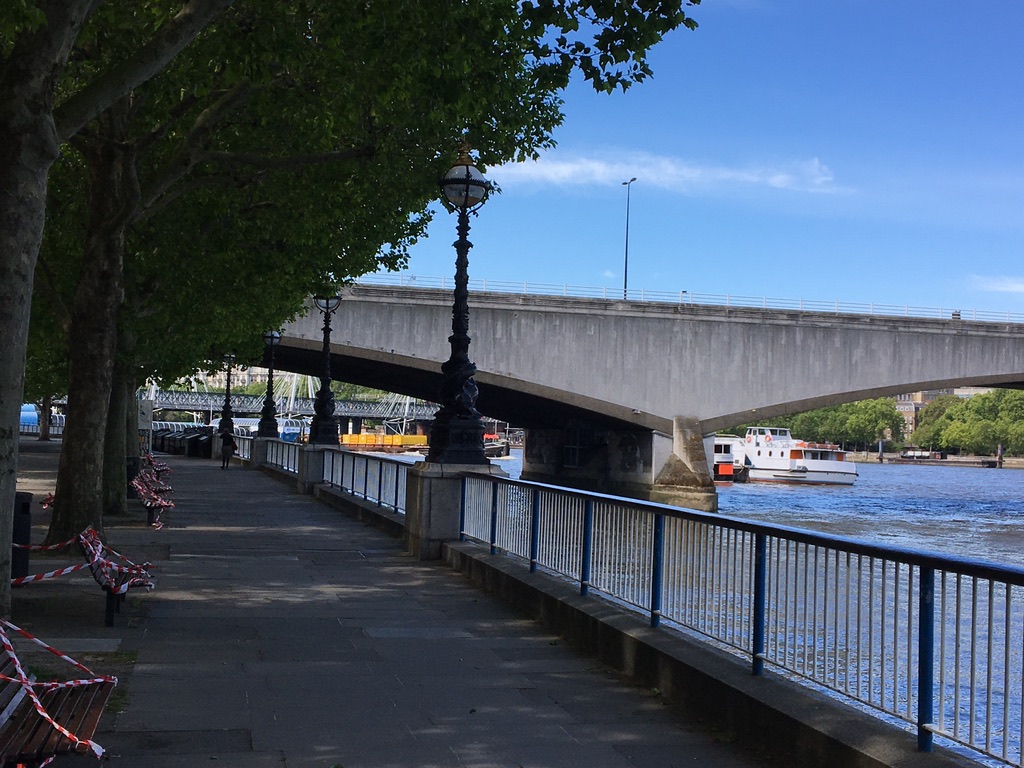
WATERLOO Bridge, or at least its current incarnation, is also known as the Women’s Bridge. It used to be called the Ladies’ Bridge, but times change.
In the 1930s, the London County Council decided to replace the original bridge that connected Lambeth in the south to the Strand and Covent Garden on the north side of the Thames. It had opened in 1817, two years after the Battle of Waterloo, hence the name.
The 30s’ project was interrupted by the war, although the half-finished replacement was officially opened in 1942.
It was not completed, however, until 1945 and largely thanks to a predominantly female workforce. Just as women took over jobs in factories and farms to replace men bound for the front, so they picked up their tools to finish the bridge.
Their reward came at the opening ceremony in December, 1945 when the Labour deputy prime minister Herbert Morrison declared that “the men that built Waterloo Bridge are fortunate men”. Well done, ladies!
Despite this initial slight, the contribution of the women has since been recognised, although promises to erect a commemorative Blue Plaque have yet to be fulfilled.
The men in this story always claimed the women weren’t deliberately ignored. It was just that the firm that built the bridge went bust and its employment records were lost. Photographs of the women bridge builders only surfaced in the last few years, proving the Ladies’ Bridge story wasn’t just a fairy tale.
Since then, some have wistfully suggested that their role is reflected in the bridge’s elegant feminine arches. Pretty fanciful, given that the plan was drawn up by Sir Giles Gilbert Scott, designer of London’s traditional but now mostly redundant red telephone boxes.
Women do appear to have a special affinity for the bridge. A group of them beat the lockdown by a couple of weeks to get their kit off for an Extinction Rebellion protest on International Women’s Day in March.
The charm of the bridge, however, is not so much the occasional topless demo as is its location, a favourite of painters and poets, from Monet to Constable, to Thomas Hood and Ray Davies of the Kinks.
Its location on a southward turn up the Thames means you can see St Paul’s and the skyscrapers of the City to the East, Parliament to the west, and much else in between.
Davies and I belong to that immediate post-war generation that just about remembers when the modern Festival Hall complex replaced the wasteland to the south to mark the 1951 Festival of Britain. It was the moment dreary London went from black-and-white to colour.
As the Kinks sang in Waterloo Sunset:
Dirty old river, must you keep rolling
Flowing into the night?
People so busy, make me feel dizzy
Taxi light shines so bright
But I don’t need no friends
As long as I gaze on
Waterloo sunset
I am in paradise
Footnote: There! I did it! A whole column under lockdown without mentioning the C-word. That’s partly in response to the complaints of some readers that I’ve been using these pages selectively to quote experts to undermine the government’s flawless response to the C-crisis or to suggest its messaging to the public might have been completely crap.
On the contrary, I admire the agility with which Johnson’s team have kept us all locked up while blaming any inconvenience on the nanny-statists. I particularly admire the government’s decision to allow cyclists to join joggers as a protected cohort that is no longer required to abide by social-distancing rules. Or that’s how it seemed today, anyway.
So, long live freedom! And keep the wrinklies indoors!
 Idle Thoughts on London Walks