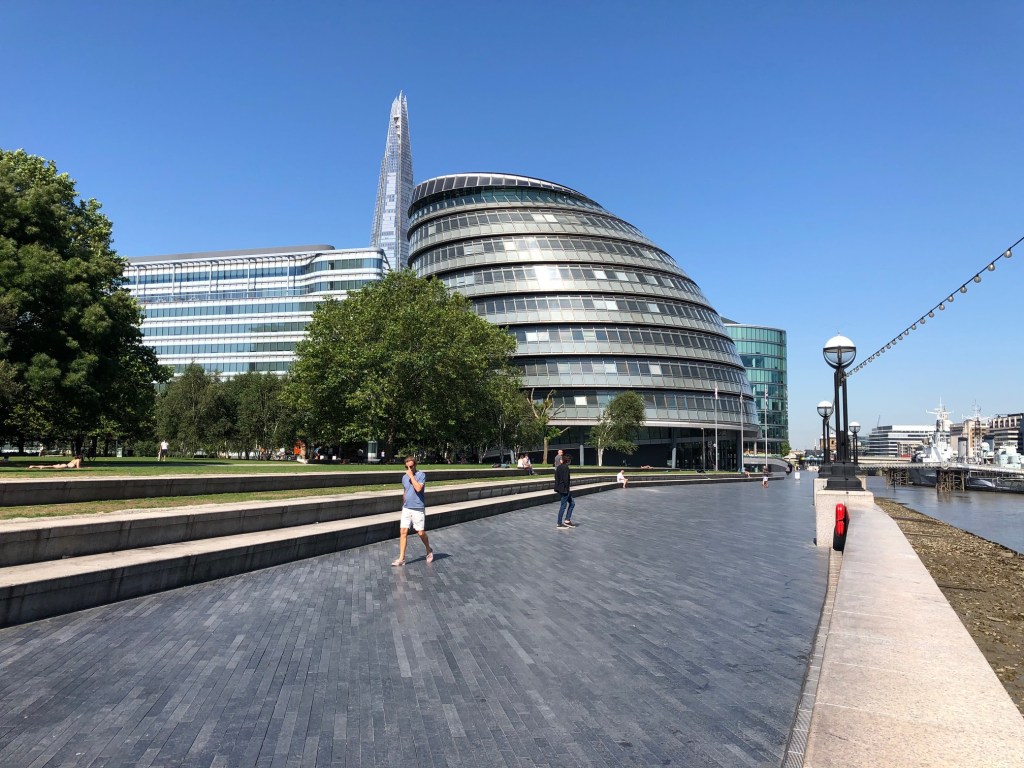
SADIQ Khan has said he wants to plug a post-Covid hole in London’s budget by moving City Hall from the riverside opposite the Tower to the middle of nowhere.
The London mayor seems a decent enough bloke. You sometimes see him scurrying towards the Norman Foster-designed bubble that has housed the Greater London Authority since it opened in 2002.
He has worked out that over the next five years the cash-strapped GLA could save £55 million it pays to its Kuwaiti-owned landlords if it decamps eastwards to Newham.
Now, just think about that for a minute. The government of one of the world’s richest and most international cities has got to move out of the centre because it can’t afford the rent!
And to Newham, for God’s sake! When the much more powerful London County Council called the shots, until it was disbanded in 1965, the site of Khan’s proposed alternative City Hall premises in the Royal Docks was still technically in bloody Essex!
The planners dithered for years over what to do with the stretch of post-industrial wasteland south of the Thames between Tower Bridge and London Bridge. They eventually settled on the banal modern urban planning solution of privately-funded corporate office blocks and luxury flats.
The saving grace was City Hall, together with the open-air theatre, the Scoop, alongside it. The developers built City Hall for £43 million, or £12 million LESS than Sadiq is now hoping to save in rent.
Heralded at its inception as “a new landmark for the capital”, City Hall was neverthelss a bit of a climbdown from the glory days of County Hall, the Edwardian Baroque edifice on the South Bank near Waterloo.
As headquarters of the LCC and its successor, the Greater London Council, it dominated every aspect of London life from education to housing, from public transport to the fire brigade, barely tipping its hat to Parliament on the opposite bank.
Teachers told us kids that it had six miles of corridors, although I’m not sure anyone ever walked them all to check.
It was abandoned after big-spending council leader Ken Livingstone’s frequent run-ins with Margaret Thatcher during which the PM complained of the anti-government billboards that were posted on County Hall’s facade.
She scrapped the Council in 1986 and its powers reverted to central government and local boroughs. The building was sold off to become part-hotel, part-aquarium.
The GLA was formally established in 2000, with the troublesome Livingstone back in the chair until 2008, when he was unseated by Boris Johnson. The rest is history.
Johnson bequeathed us “Boris” bikes (they’d been Ken’s idea) and a bunch of pet projects that never went ahead, except for his one to become prime minister.
Municipal London is essentially dead. It relies on stingy, controlling and centralising governments at Westminster for additional funds. Its elected but now essentially advisory council has few real powers. The Mayor proposes policy and the councillors can merely try to hold him to account.
The GLA doesn’t directly run any services, but merely presides over bodies that do. These include Transport for London, entirely funded by ticket sales, which have been virtually non-existent for the past three months. Hence Sadiq’s scramble for savings.
He can’t sell off any libraries, youth clubs or open spaces because most of those were disposed of years ago.
So he says he’s got no choice but to move out of the jewel in the crown. What will City Hall become? Another corporate office? Just what we need.
I am personally prepared to do a deal with Khan. I’ll drop my opposition to the City Hall move, if he reinstates the RV1 bus.
This nifty single-decker, linking the south bank of the Thames from Tower Bridge across to Covent Garden, was my favourite route until he scrapped it last year. More money-saving, we were told.
It won’t have escaped your attention that the route sounds like “The ‘arvey One.” I was devastated when it disappeared and suddenly realised how the Queen must have felt when they beached the Royal Yacht Britannia.
 Idle Thoughts on London Walks