Russia report: All quiet on the Londongrad front

GIVEN all the headlines about meddling Russians, it seemed a good day to head to the heart of what Parliament’s Intelligence and Security Committee describes as Londongrad.

The hunting and grazing grounds of London’s Russian oligarchs have no fixed border. But the epicentre would definitely include Knightbridge for the shops, Mayfair for the clubs and Belgravia, an area where even some of the English gentry have swapped their gracious piles for piles of Russian roubles.

As the committee put it, Britain welcomed Russian money, with few, if any, questions asked about the provenance of this considerable wealth which then went on to be recycled through the London “laundromat”.

Sadly, dear reader, the budget of this column is too meagre to breach the bastions of the crème de la borscht of the city’s Russian elite. So, for once, we’ll have to make do with pressing our noses to the window pane.

For, unless you’re a society hostess, a Tory MP, or one of the army of expensive lawyers and bodyguards who keep the expat Russians safe, the average punter is unlikely ever to rub shoulders with them.

The committee report also mentions a wider army of British enablers who minister to the needs of London’s Russian elite: “Lawyers, accountants, estate agents and PR professionals have played a role, wittingly or unwittingly, in the extension of Russian influence which is often linked to promoting the nefarious interests of the Russian state.”

The nearest most of us are likely to get to them is by watching McMafia, the crime drama based on journalist Misha Glenny’s non-fiction journey through the global criminal underworld.

Back home, the Russians have their own TV series, Londongrad, which gives a comic and somewhat idealised view of their compatriots’ lives in the British capital. It centres on an agency that troubleshoots for the Russian super-rich.

An almost equally rosy view was provided by society magazine Tatler, which was allowed a brief glimpse into the lives of the sons and daughters of London’s Russian plutocrats.

“From Ascot to Annabel’s, Henley to Harrods, they are the new generation of Russian-born, UK raised ‘little tsars’ adding their unique brand of glitz to British high society,” Tatler drooled. Pass the sick bag, Ivan.

Twenty-something Anna Milyavskaya enthused: “When I lived in Belgravia, every second person was Russian. Sometimes you’d be like: ‘Am I in Moscow or am I in London?’ ” Neither, darling. You’re in Londongrad.

When they are not headed for Ascot or shopping at Harrods, the Russian set hang out in the Mayfair clubs racking up the bar bills. The record set in 2013 for a £130,000 round – “Let’s split it,” said the two multimillionaire Russian tipplers – appears to be unbroken.

Despite these excesses, and the suspicion that some of them are involved in a Putinesque plot to undermine our democracy, they get a pretty easy ride from the great British public.

You never hear That Bloke Down the Pub declaring: “Bloody Russians! Coming over ‘ere, taking all the places at Eton! Jumping the bloody queue at the Ritz!”

Even this week’s report refers to Russian “expatriates” rather than immigrants. The former is a term the British generally reserve for themselves to describe any exiled Brit, from a monolingual geriatric on the Costa Brava to a tax-evader in Monaco.

It was slim pickings in Londongrad today. I’d intended to doorstep a few Russians to ask if they’re really buying up London in order to hand it to Mr Putin. Zilch! The usual haunts, including the Russian restaurants around Knightsbridge, were empty.

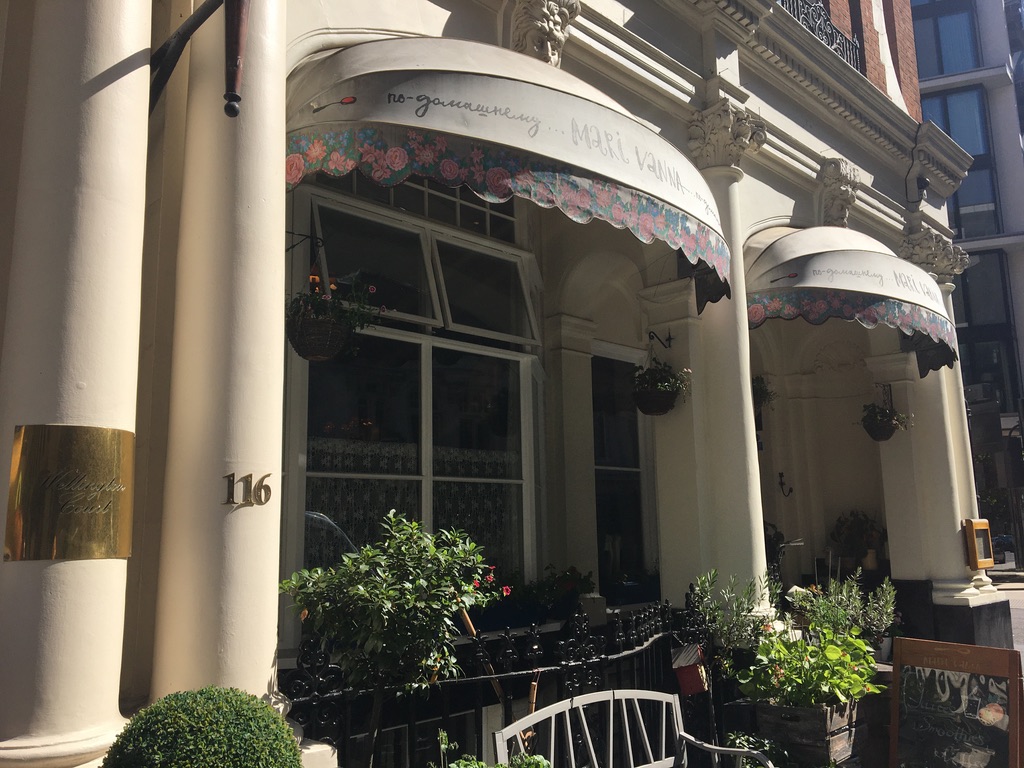
(Pictured today is Mari Vanna’s – branches in Moscow, St Petersburg and New York – which offers Russian food for a modest English budget. Just don’t order the Beluga at £100 a spoonful).

Maybe the Russians are lying low, given this week’s negative publicity, or maybe they fled to sunnier climes months ago to escape the virus. Then I remembered one of the younger set telling Tatler that most fashionable Russians go to the Tuscan seaside town of Forte dei Marmi every summer.

So the walk to Londongrad was a bit like going back to the old Soviet era, when you never met a Russian in London, apart from the odd “diplomat” or “journalist”, because the mass of the Russian population just didn’t get out much.

In my old Associated Press days in the seventies, there was a young Russian who would splash the cash at the Hoop and Grapes, just round the corner from Fleet Street. He favoured English tweed and corduroy and said he worked for the Soviet news agency Tass.

MI5 tried to warn us off, saying he was a spy. Er, thanks, we’d sort of worked that out.

Did the spooks really think us hacks would sell out our country for a measly pint of beer? Now, if he’d had 130,000 smackers behind the bar and the VIP slot at Annabel’s…
Passport to Pimlico: central, continental, but beware of MPs

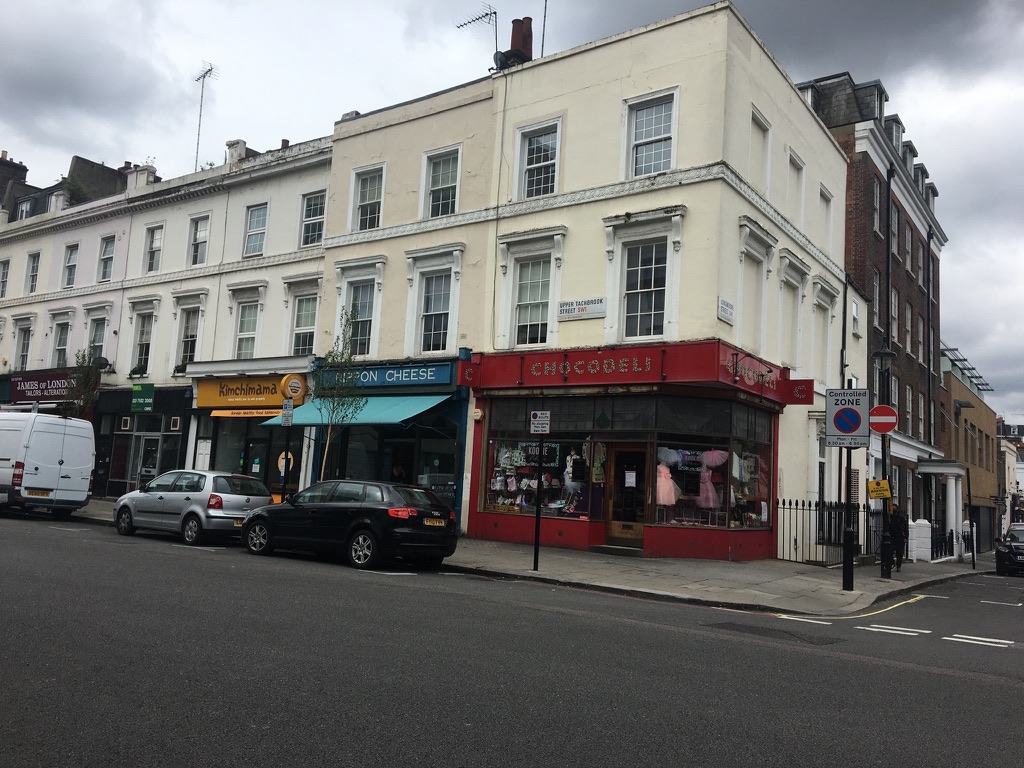
SO I’m strolling near the corner of Warwick Way in Pimlico, minding my own business, when who bounds out of a shop and almost runs into me but former Tory grandee Michael Fallon, besuited, maskless and wearing a satisfied grin.

And who can blame him? The former defence minister bailed out before last December’s election and went into the oil business, thereby avoiding any association with the Johnson government’s coronavirus car crash.

Sir Michael lost his minister’s hat in 2017 after being accused of “repeatedly and inappropriately” touching journalist Julia Hartley Brewer’s knee under the dinner table 15 years earlier. No comment.

His more serious crime though was to be a Remoaner, albeit a reluctant one. And, with a swivel-eyed Brexiter Tory victory looming, he sensibly decided to call it a day.

Anyway, where was I? Ah, yes. Pimlico.

You’re always in danger of running into a politico, ex or extant, in Pimlico because Parliament is only a 10 minute trot away. Estate agents punt flats in the neighbourhood as pieds-à-terre for MPs on the basis that it’s within range of Parliament’s division bell. If they get their skates on, they can just make it to the voting lobby.

I’ve always had a soft spot for Pimlico – my grandfather had a fish shop in Tachbrook Street long before my time – although I don’t have much occasion to go there these days. It has generally been regarded as a bit of an enclave, more famous for what it’s near than for what it is.

There is nearby Westminster, of course, and Victoria Station and the fast train to Brighton at its northern edge, while a quarter hour stroll gets you to Buckingham Palace.

Even in the gloomy fifties it had a certain cosmopolitan charm, stirring seductive thoughts of a then distant Europe and all that exotic foreign stuff like café au lait and spaghetti and flamenco.

That image was perhaps in part a hangover from the 1949 Ealing comedy “Passport to Pimlico” in which the fictional rationbook-era locals discover an ancient charter proving they’re actually part of the Duchy of Burgundy.

In the film, a Pimlico woman shouts from her window: “We’ll always be English and that’s why we’re sticking up for our right to be Burgundian.” It sounds like a pro-EU slogan avant la lettre.

The district was mainly marshland and market gardens until the 1820s when Thomas Cubitt was hired to develop the area with handsome stucco terraces and squares. For most of the 19th century it was home to the “better sort”, middle class families and aspirant tradespeople.

By the middle of the 20th, however, it had gone downhill somewhat and became a convenient spot for the peers and plutocrats of the more affluent Belgravia and Mayfair to park their live-out servants.

I had an aunt who was what in those days was called a lady’s maid. She ministered to the needs of the wife of a captain of industry known to everyone as “the Colonel”.

As part of her wages she was given a rent-free floor in Pimlico’s elegant St George’s Square, the only square in London that is bordered by the river. These days the flat would fetch somewhere north of a million.

Her generous employers took my aunt and uncle to Monaco in 1956 for the wedding of Prince Rainier and Grace Kelly. Well, someone had to be on hand to iron the colonel’s wife’s frock.

I would often spend the weekend at St George’s Square and sometimes hung out with the family of “Uncle” Ernie the bookmaker who had a basement flat in Pimlico’s more proletarian Denbigh Street.

In the era before betting shops, gambling was a semi-clandestine world of bookies’ runners and betting slips passed in pubs. A visitor at Ernie’s once took us kids out to the yard to discreetly show off the handgun he was packing.

The neighbourhood has gone back upmarket in recent years. But the small shops and food stalls have survived and, like much of central London, it’s now more cosmopolitan than ever. The Pimlico Academy even offers flamenco classes.

Strolling homewards through Parliament Square, I spotted that anti-Brexit campaigner with the bowler hat who’s been hanging out there for the past four years. He and a line of bored looking police were preparing for the latest demo.

Someone had strung a banner on the railings of Parliament. “Self-serving idiots are destroying our nation,” it read. I couldn’t help thinking: “You’re well out of it, Michael Fallon.”

South East London noir: farewell to a screen pioneer

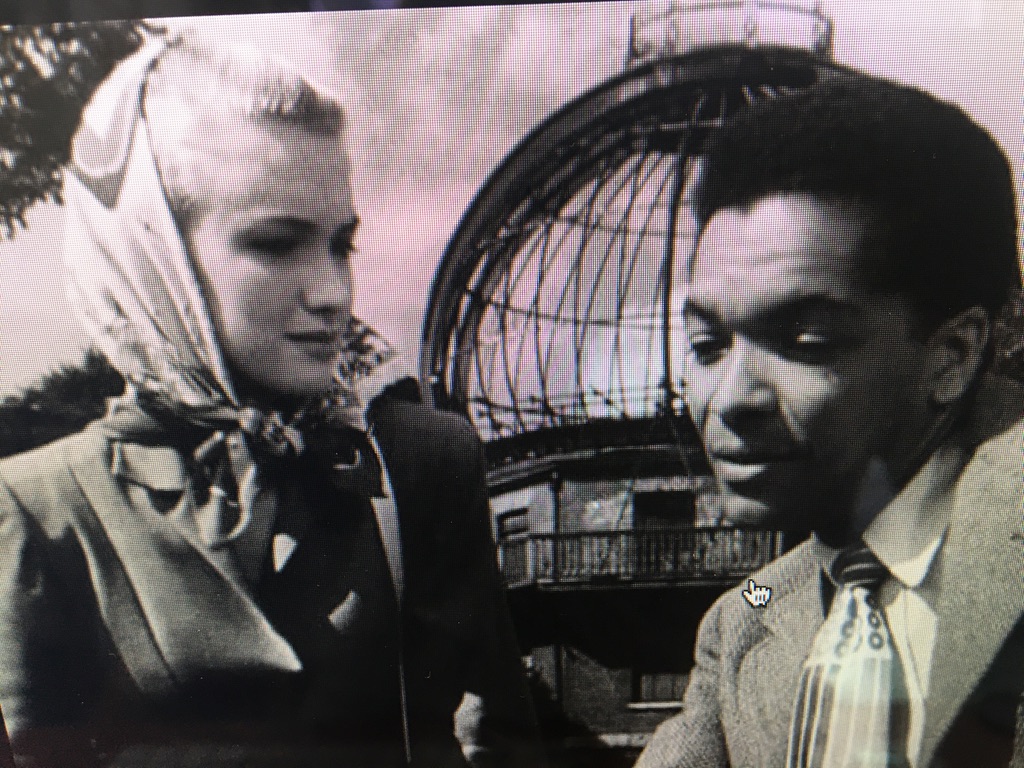
EARL Cameron, the Bermudan-born actor who starred in the 1951 film The Pool of London, died peacefully at home this week at the impressive age of 102.

His leading role as a Jamaican merchant sailor on a weekend of shore leave was a first for a black actor in British cinema. So too was his tentative screen romance with a white woman, played by Susan Shaw.

You could say, however, that his real co-star was south east London, which provides the backdrop to what is essentially a routine London noir about a jewel heist gone wrong.

Filmgoers used to having their weekly diet of romance or drama set in a Mayfair drawing room or an English country house were instead treated to a crime story made largely on location at the wharves in Bermondsey and at the Borough, Camberwell and Greenwich.

There are scenes set in Borough Market and Southwark Cathedral.

One of Cameron’s shipmates even jumps on a tram that will take him to New Cross, although either the budget or the plot precluded filming that far into the south east hinterland.

The Pool is still worth watching for its its critique of contemporary racial attitudes but also for its snapshot of a changing London emerging from the post-war grime with many of its habits and social mores still intact.

Some scenes are set at the Camberwell Palace of Varieties, an old fashioned music hall where in those days boys were still employed to set out the limelight lamps ahead of an evening of songs, jokes and acrobatics.

Within five years, the Palace had shut down and soon afterwards its ornate interior was demolished.

As for the trams, one character remarks that they too will soon be scrapped.

Much of the action takes place around the south bank of the pool of London where The Dunbar has moored after its voyage from Rotterdam. The crew prepares for a night ashore by stuffing their pockets with innocent bits of contraband, pocket watches and nylon stockings, to sneak past the customs men.

The Scottish chief engineer, played by the sonorous James Robertson Justice, opts to stay on board with a couple of bottles of brandy for company. Of London, he says: “Walk within the shadow of its walls and what do you find, filth and misery.”

On a boat trip to Greenwich, Cameron’s character, Johnny, explains the significance of longditude to his wide-eyed new girlfriend and reflects on the problems of race. “You wonder why one man’s born white and another not,” he muses. “It matters. Maybe one day it won’t.”

Perhaps we haven’t got there yet, as Cameron himself reflected in old age.

Having acted on the stage after arriving in Britain in 1939, The Pool of London was his screen breakthrough. He went on to win prominent parts in cinema and television for the rest of his career, including a supporting role in the Bond film Thunderball.

“Unless it was specified that this was a part for a black actor, they would never consider a black actor for the part,” he recalled in a 100th birthday interview. “And they would never consider changing a white part to a black part. I got mostly small parts, and that was extremely frustrating – not just for me but for other black actors.”

His breakthrough 1951 film highlights the prevailing prejudices, just a couple of years after the arrival of the Empire Windrush marked the start of large-scale immigration from the Caribbean. (Sadly, some members of that generation are still struggling for compensation from a government that illegally kicked them out).

“They’re all the same,” says one character as Johnny is ejected from a pub. “You must be hard up to go with him,” a unsympathetic white woman sneers at his girlfriend.

There are some jarring notes. The “nice” girls all speak with cut-glass, middle class accents while only the gangsters’ molls speak Sarf London.

Much has changed in the area in the decades since the film was made – although many would say not enough.

When Johnny asks for directions to Camberwell Green, he’s told to get the 42 bus on Tower Bridge. That’s a route that opened in 1912 and is still running to this day. At least some things in south east London never change.