APOLOGIES for the paucity of pubs.
A rough review of my Covid-era ramblings indicates they have dwelt longer on London’s graveyards than on its boozers.
For, even after the pub closure order was eased in July, the latter had lost much of their charm.
I don’t know about you but I never quite adapted to the new order – card payments and table service. What other continental aberrations await us? Tipping the bar staff?
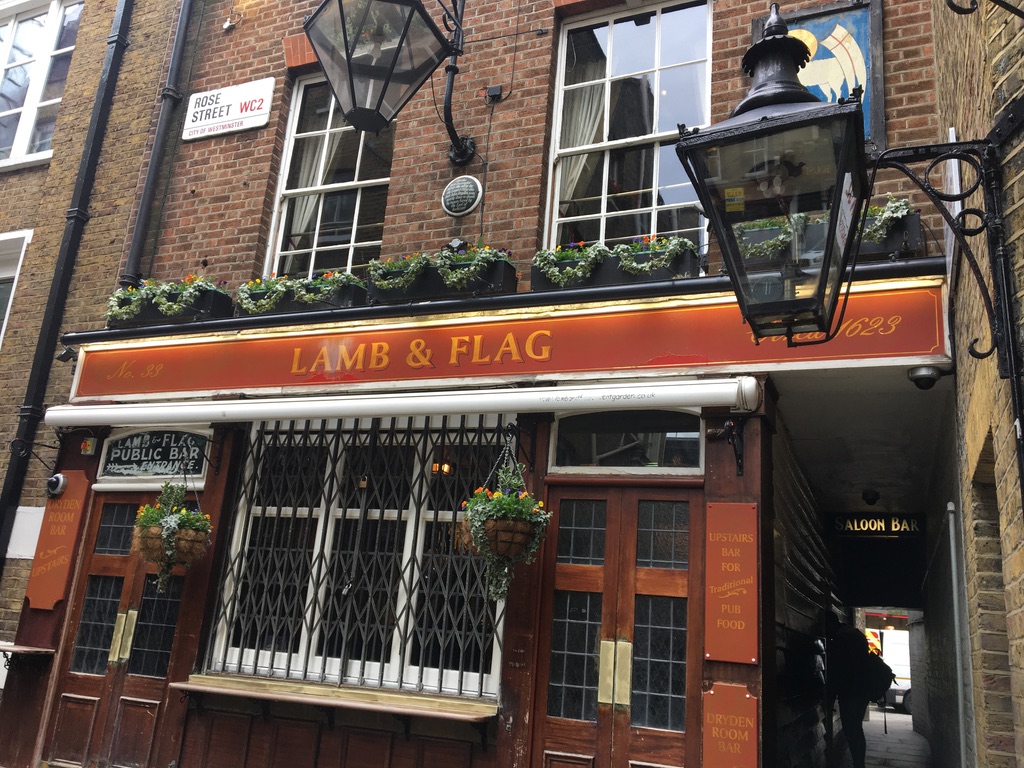
In better times, we Londoners all have our favourites. Mine would include the Lamb and Flag, wedged up an alleyway in Covent Garden. Blink and you’d miss it. I contemplated an early pint there this morning. Tough luck. It was shut.
The listed building is these days officially “historic”, meriting TripAdviser ratings and snaps on Instagram.
It wasn’t always like that. The surrounding Garden used to be what a modern Londoner would regard as “well rough”. It was where the 18th century graphic satirist William Hogarth located his Gin Lane.
The previous century wasn’t much better. A plaque over the Lamb commemorates the day in 1679 on which the poet John Dryden was roughed up by a bunch of heavies hired by his tearway poetic rival John Wilmot, 2nd Earl of Rochester. Wilmot was upset about a Dryden poem that took the piss out of one of Charles II’s mistresses.
By the 19th century, the pub’s association with ultra-violence was formalised with the addition of a bare-knuckle prize-fighting ring. That earned it its contemporary nickname: The Bucket of Blood.
London has a long-standing boxing-boozer tradition. The Ring, a converted chapel in Blackfriars Road, was the home of British boxing from 1910 until the Luftwaffe bombed it. The pub of the same name is all that survives.
Not far away in the Old Kent Road, the gym over the Thomas a Becket pub trained generations of boxers, including London’s heavyweight champion ‘Enry Cooper – the man who once floored Muhammad Ali.
The connection between pubs and pugilism wasn’t always so formal.
I grew up dead opposite the Five Bells at New Cross Gate, down the road from the Becket and run for a time by Joe Lucy, a retired British lightweight champion. Joe trained at the Becket where he claimed to have several times encountered three ghostly nuns. Go easy on the sauce, Joe!
Anyway, the point of the story is that, during Joe’s time at the Bells, the street outside was a regular venue for Saturday night brawls between the patrons. Deptford police could set their watches by it. Maybe the customers were trying to emulate the landlord. Or maybe they were just pissed.
Lucy was succeeded by Stan Blake, an imposing figure who was also handy with his fists. He’d been an amateur boxing champion in the army. He was the archetype of a cockney mine host, from his military mustache to his yellow waistcoat to his gold-edged cigar holder. Under his tutelage, the brawlers calmed down and the Bells became a venue for weekend family sing-songs.
But where were we? Ah, yes, the Lamb and Flag.
It’s an intimate if anonymous West End pub. You don’t go there expecting to bump into your mates. But the staff are friendly and there’s a shelf outside where you can park your pint if you want to have a fag.
Dryden’s alley is as dark and narrow as it was in 1679 but you’re less likely to be cornered there by agents of a belligerent aristocracy than you would have been in his day.
The Lamb has venerable literary connections. Not just Dryden himself but also Charles Dickens, who was a regular. Richard Sheridan the playwright and the poet Samuel Butler were locals.
I saw Graham Greene in there one day, propping up the bar and trying not to look like a man waiting for a tryst with one of his spook contacts. In the spirit of the place, I should have said: “Oy! Greene. Who do you think you’re looking at? Wanna take this outside?”
But naturally, dear reader, I didn’t.
 Idle Thoughts on London Walks