SUCH was the dire economic news from the City that it was with some trepidation that I crossed the Thames, half-expecting to find the starving orphans of futures traders begging for pennies on the Guildhall cobbles.
The remoaning Financial Times had set the ball rolling by gleefully reporting that the Square Mile had been overtaken as Europe’s top share trading hub by Amsterdam.
That set off a spate of grim prophecies of the end of the City’s financial supremacy as a result of the UK’s liberating departure from the EU.
It was small consolation that Dominic Raab, the government’s minister for dealing with Johnny foreigner, assured us that as an inevitable consequence of the Brexit Bounce the Europeans could be expected “to nick a bit of business here and there”.
To be fair to Dom, there were few signs of the coming Apocalyse among the lanes and alleys around the Royal Exchange and the Bank, no weeds sprouting in the cracks of Eastcheap or of Bevis Marks, no begging children.
The streets have already been pretty dead for a year and a Friday is now more like a pre-pandemic City Sunday. Most of its half million regular workforce is staying at home and virtually no one actually lives there.
Just a little over 8,000 people can technically call it home and more than half of them are at the Barbican, a brutalist estate built in the 1970s to offer banking fat cats a pied-à-terre near the office.
That’s less than one in a thousand Londoners and not much more than the 6,000 who lived in Londinium when the Romans were still around. In other words, it’s an ideal spot for the urban rambler to get away from it all and revel in London’s most historic quarter without the distraction of other people.
Frankly, nobody else bothers to go unless they have to. The City of London Corporation maintains a what-to-do site that reveals that there’s really not much to do. Even tourists, when there are any, tend to give it a wide berth apart from the A-list sites on the fringes such as St Paul’s or the Tower.
It’s certainly not party central. Look at it this way: if the lockdown ever ends, no one is going to suggest celebrating with an all-night piss-up in Throgmorton Street or Poultry.
We Londoners sometimes forget that, until about 1800, the square mile was all there was. Outside the mostly invisible line of the Roman wall, there was mainly farmland and marsh and the occasional hamlet.
The journey to rustic settlements such as Peckham was so perilous that stagecoaches would only venture there with an armed guard. Some things don’t change!
The old City had yet to become synonymous with high finance. The money dealers of the day lived above the shop, alongside the drapers and tailors and skinners and scriveners and all the other trades whose memory survives in the livery companies that still bear their names.
All human life was there. Well, almost. The prostitutes and actors and bear-baiters were kept across the river in Southwark which was incorporated into London for four centuries as the Ward of Bridge Without.
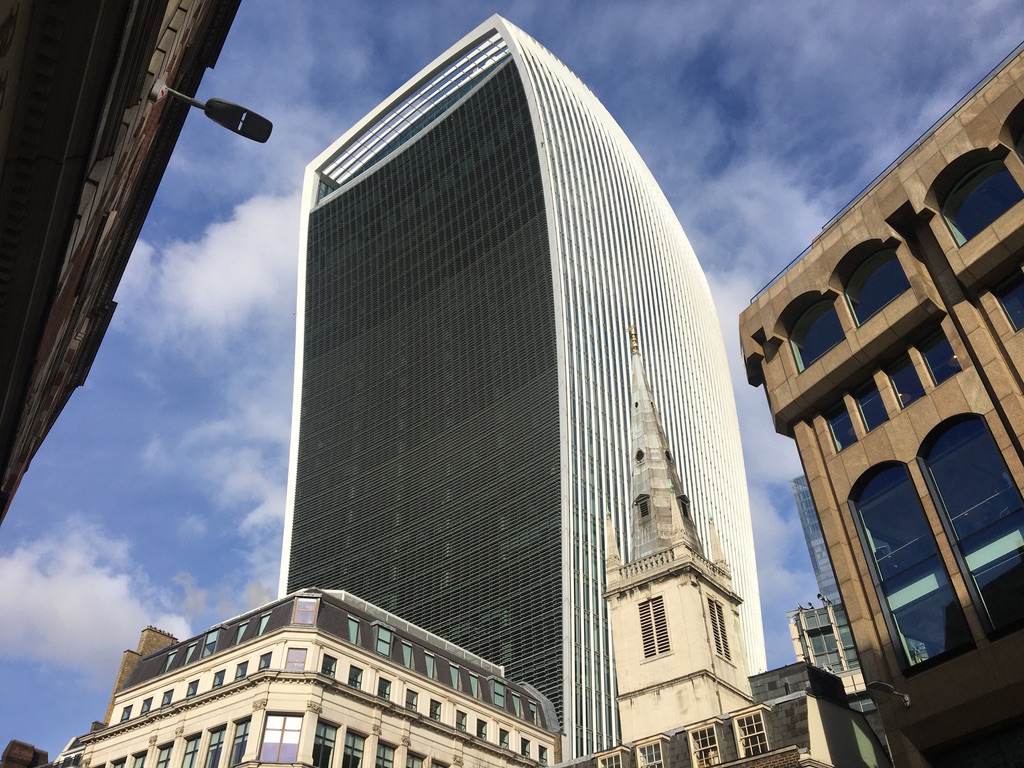
The City took a hammering in the blitz and the post-war population dropped to 5,000. St Paul’s Cathedral was its tallest building until 1980 when the NatWest Tower went up. That was followed by a dozen more with increasingly esoteric nicknames such as the gherkin. (Today’s pic features the walkie-talkie, a building that’s better in than out).
What’s to become of them, now that London’s entire financial system is said to be threatened with collapse because Boris Johnson failed to read the small print in his world-beating deal with Brussels?
Already there were questions about how many bond traders, hedge funders, and dealers in invisibles or intangibles or whatever they’re called, would actually return to their desks after Covid. It’s probably cheaper to keep them working from home until robots finally replace them. The survivors can always decamp to Frankfurt.
As for the City and its highrises, we could knock them down or turn them into workers’ flats or make the whole square mile into a Brexit theme park. How about a novelty mechanical treadmill for the kids to teach them about the good old money-making days? You could charge in Bitcoin and call the ride The March of Folly.
 Idle Thoughts on London Walks