King’s Cross: below the surface of “world-beating” London

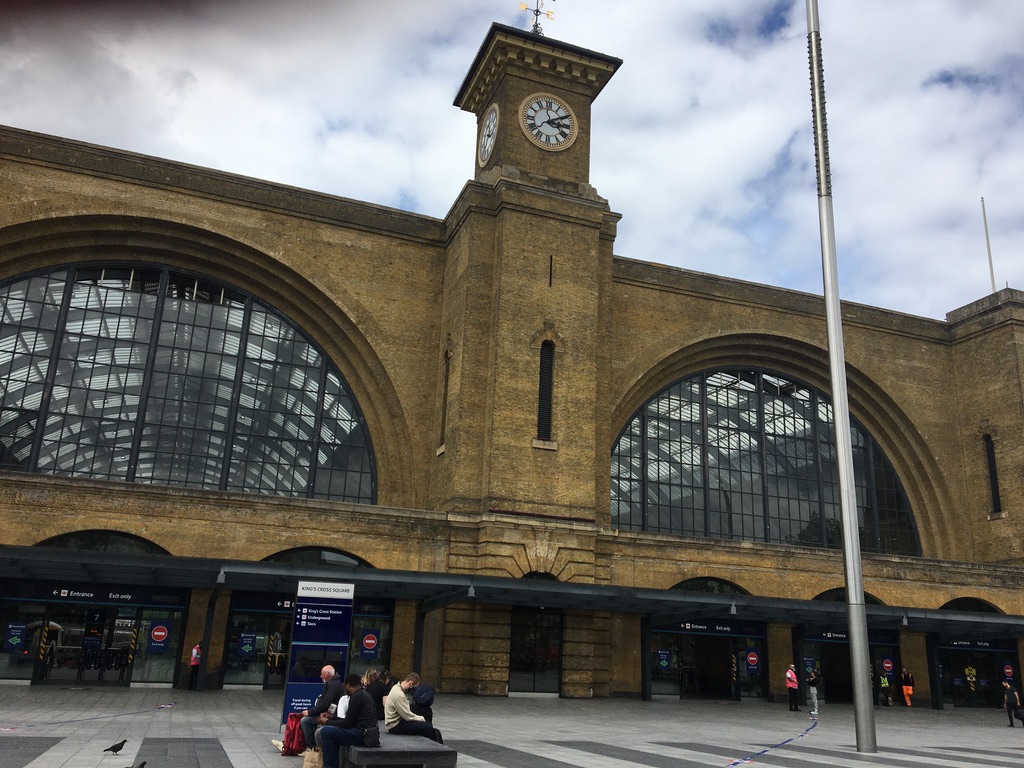
KING’S Cross. For some people it’s been the stepping stone to a new adventure, for others it’s been the end of the line.

With varying degrees of aspiration, desperation and trepidation, generations of Scots and northerners took the night train south to the once grimy terminus to chance their arm in London, or as they used to call it, The Smoke.

Some of them, like Tom Courtenay’s fictional anti-hero in the 1963 film Billy Liar, bottled it at the last minute, leaving the glamourous Liz – Julie Christie – to set off alone on her London adventure.

The area around the former Great Northern Railway terminus and the Gothic folly of St Pancras next door has maintained its air of transitoriness despite a major clean-up in the 1990s intended to eclipse its reputation for prostitution and drugs.

Before that, predators lurked in the gloom of the old station entrance to lure northern teenage runaways straight off the platform and into their nefarious enterprises.

Those were the days when no self-respecting London TV noir would fail to include at least one scene of a traditional King’s Cross kerb-crawler eyeing the pavements for talent along the dark walls that hid the railway tracks.

The old coal yards, gasholders and canalside warehouses to the north of the platforms are now the site of one of the largest 21st century regeneration projects in post-industrial, “world-beating” Britain.

The old pay-by-the-hour B&Bs and gloomy wino hangouts have been replaced by bijou artesan eateries. Incidentally, these have responded nobly to the lockdown by offering brown bag vegan takeaways and chilled Sauvignon at barely a score a head in order to keep the wolf from the door.

Over a couple of decades the British Library and the Guardian newspaper moved into the area and latterly the Francis Crick Institute life sciences hub, Europe’s biggest biomedical research centre, along with new museums and art galleries.

Google is in the process of building a £1 billion, 11-storey London HQ, its first such wholly-owned project outside the US, and one that was temporarily halted when one of its contractors went down with the coronavirus.

Arrivals these days seen hurrying out dragging their cabin bags are more likely to be weekend warriors commuting from Paris or Brussels as workseekers from Newcastle or adventure-seeking shopgirls from Stoke-on-Trent.

But, after dark, none of them linger long in the square. Despite the changes, King’s Cross has yet to quite shed its predatory feel.

Daytime is okay. Parents even bring their kids to see King Cross Station’s latest attraction, the Harry Potter Merchandise, Souvenirs and Collectables shop next to a sign for Platform 9 3/4 from which J.K. Rowling’s fictional child heroes headed off to school.

I used to pass for a while through just such a secret door at King’s Cross. I coudn’t find it this week so maybe, like the fictional platform entrance, it’s been bricked up.

It was the gateway to a subterranean world as weird in its way as Hogwarts. Like the Phantom in the Paris Opera, you descended in the gloom to a vast labyrinth of workshops and storerooms that never saw the light of day.

Like him, you almost expected to reach an underground river, which in the case of King’s Cross would surely be the long ago boxed-in River Fleet.

One vast area was run by a Czech emigré who bought cheap sports gear from the eastern bloc and sold it at such a hefty mark-up that half was allowed to rot in the network of vaulted tunnels and dead ends.

The permanent crew were a bunch of cricket-mad lads from St Lucia who liked to haughtily stress their superior status by refusing to speak anything but creole French, except to shout orders at the native temps.

They were the only ones who got to drive the second-hand electric milk floats needed to ferry supplies around their underground domain.

Their foreman was an older, book-loving man, also from the Caribbean, who was transitioning from Jesus to socialism.

Where are they now? Where are the storerooms for that matter? It’s all trendy shops now where the descent to the underworld began. Maybe there’s still a secret entrance for the initiated just like at Platform 9 3/4.

Perhaps that parallel, subterranean King’s Cross still exists, beyond the ken of the new inhabitants at Google or the Crick. So, should you find yourself in the area one dark night, don’t go wandering through any unmarked doors.
Lockdown eases: time to get back in the boat

DON’T tell everyone, but the Thames Clippers are back.

These nippy London catamarans were withdrawn from service at the beginning of the lockdown but went quietly back into operation at the start of the week.

They’re a godsend for the city’s urban amblers, easing the strain by extending the range of potential idle walks from the Royal Arsenal at the thick end of the river to Putney at the thin.

I opted for an early boat to Greenwich, an old stomping ground, in the company of just two fellow passengers who in any case jumped off at Canary Wharf.

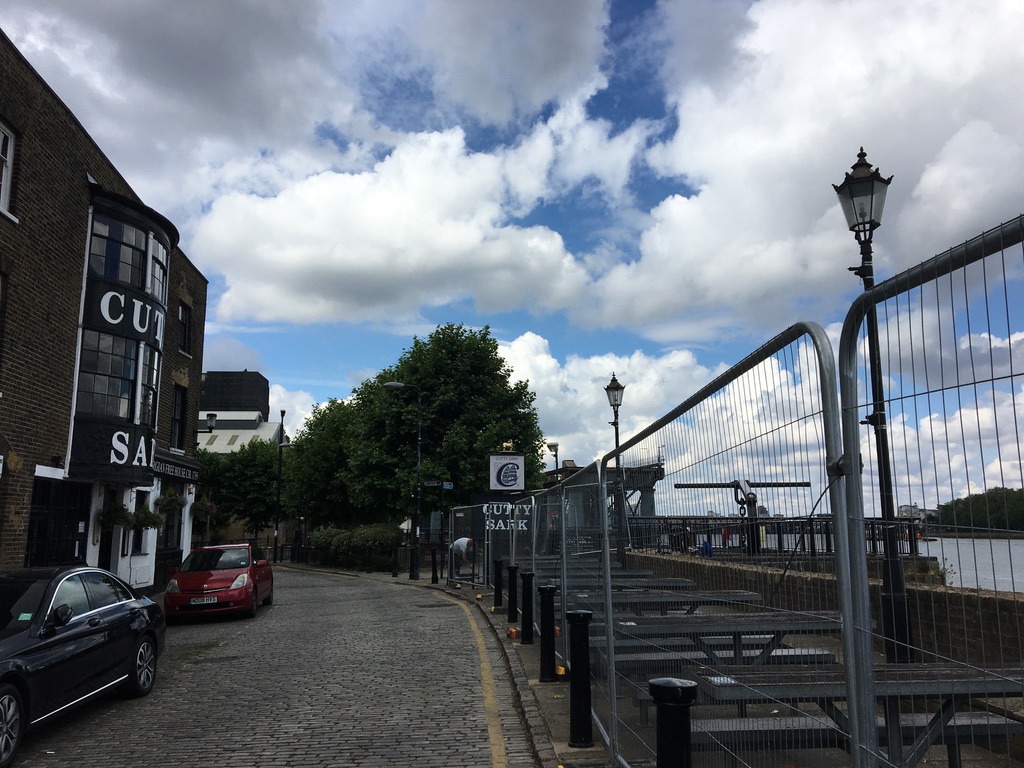
At weekends when we were still in our teens, we would invariably head down to Greenwich and the Cutty Sark – the pub, silly, not the ship!

The Georgian building on Ballast Quay, beyond the old travelling crane jetty that juts out over the river, used to be called the Union Tavern. Then, it was the watering hole for foreign seamen, bargees and workers at the local wharves in an era when London was the world’s largest port.

It had a bit of a dodgy reputation in those days. Even our mate’s nautical dad, a former naval rating, merchant seaman and lighterman, said he always gave the place a wide berth.

By our time in the early ‘60s, when the pub had been renamed after the tea clipper put into permanent dry dock just west of the naval college, it was deemed safe.

But you still sometimes got a flavour of the old days. One evening a coaster from Holland moored at the river wall in front of the pub. The noisy crew jumped over, headed for the bar and proceeded to get happily plastered without ever losing a grip on their Dutch-accented cockney.

It’s maybe not the kind of Greenwich experience you can look forward to these days.

David Abulafia, historian of the oceans, was on the radio today, musing on the revolution that has happened to the world’s ports since the advent of containerisation.

With modern ports such as Felixstowe now more machine than human, he said, there’s no longer the wharfside jostle and swap of cultures you used get in places like riverside London.

Greenwich still gets its fair share of foreign tourists, although not so much in recent months, hence the near empty catamaran. They mostly come for the palace and the park, the naval museum and the observatory. Favourite is a selfy with one leg either side of the Greenwich meridian.

For us, Greenwich and Ballast Quay were where the rest of the world started: the Pool of London behind us and, ahead, Asia, South America, Africa, the Caribbean, or wherever else the ships we saw had come from.

Some nights we would leg it through the narrow foot tunnel to the Isle of Dogs and The Waterman’s Arms. The broadcaster Daniel Farson bought the place in 1962 with money left by his American war correspondent dad, Negley Farson.

Farson senior once took young Dan on assignment to Germany where he got his head patted by Hitler.

When he moved east, some of his Soho set followed. And glamourous young people from beyond the West End would turn up for a wild night of bopping and jiving in darkest Poplar. Dan tried to turn the place into an old-fashioned music hall, but the money ran out.

In a way, like Ballast Quay opposite, it was a place where, for us, the rest of the world started.

Monumental cock-ups: who gets to pick London’s statues?

THERE is no way I am going to get involved in the culture wars over the fate of the nation’s statuary. You will all have your own opinions about whether slave trader Edward Colston belongs on a pedestal or at the bottom of the Bristol Channel.

However, the current kerfuffle over which monuments should stay and which should go does raise one interesting question: who decides in the first place who gets a statue?

Such choices are often controversial and they are not made overnight. Churchill didn’t get his statue in Parliament Square until 28 years after Victory in Europe and Margaret Thatcher didn’t get one at all.

Westminster Council rejected a Thatcher monument on the grounds it was likely to be a magnet for protestors. The bronze was shuttled off to Grantham where, even in her provincial birthplace, police warned it could become “a target for politically-motivated vandals”.

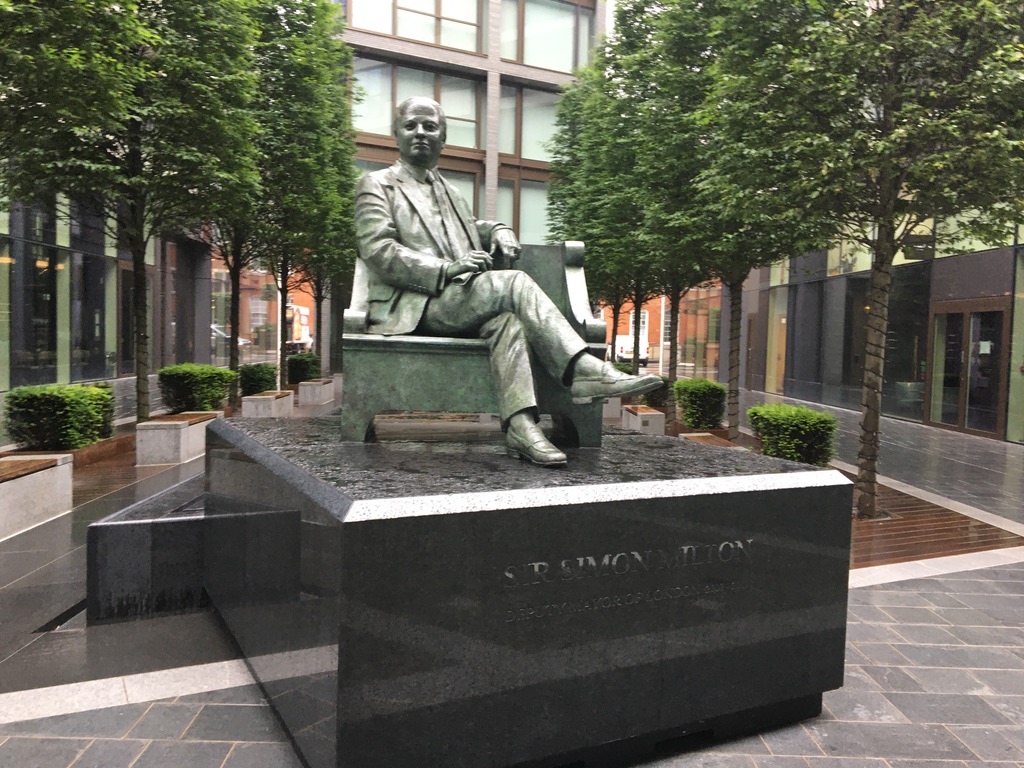
The authorities appear to have had no such qualms in the case of Sir Simon Milton, the most memorialised man in London.

“Sir Simon Who?” I hear you cry. It’s certainly true that, as someone who merits not one but five memorials in the city, as well as a plaque and a square in Victoria named after him, he remains a relative unknown to most of us.

The tributes include a statue in the Sir Simon Milton Memorial Garden in Paddington, a bust in Piccadilly and, most recently, a larger-than-life seated figure near City Hall at the southwest corner of Tower Bridge (today’s picture).

It sits in the quadrangle of the new, unsightly luxury development that houses the Bridge Theatre. It was originally on the walkway outside, where it got in everyone’s away.

So who was Sir S and why such a monumental fuss?

Raised in north London, he was a Conservative councillor and subsequently leader of Westminster City Council until 2008. He had been director of a lobbying firm embroiled in Parliament’s cash-for-questions scandal.

When he was a simple councillor, a predecessor as leader, Lady Porter, did a runner after Westminster was accused of gerrymandering in a homes-for-votes scandal that involved selectively selling off council houses to those more likely to vote Conservative.

But Milton’s biggest claim to fame was that he served as Boris Johnson’s deputy and chief adviser when the current prime minister was mayor of London from 2008. He was the brains behind the bluster and Johnson returned the favour by unveiling his City Hall statue in 2016.

He was to Johnson then what the lockdown-dodging Dominic Cummings is today.

Milton died in 2011 at the sadly premature age of 49.

So why all the statues? The Tory website Guido Fawkes archly remarked that it surely had nothing to do with the fact that Milton’s longtime companion and civil partner, Robert Davis, had been in charge of planning at Westminster Council.

Davis, a former Lord Mayor of Westminster, stepped down as the council’s deputy leader in 2018 after he was found to have accepted hospitality and gifts on more than 500 occasions, most of it from property developers.

During his time as a planner, Davis removed five busts of the likes of Sir Isaac Newton and satirist William Hogarth during an ugly and mindless £15 million remake of Leicester Square.

At least there’s room now for a Boris bronze or even a discreet Cummings cartouche.

Transforming London: Elephants don’t forget

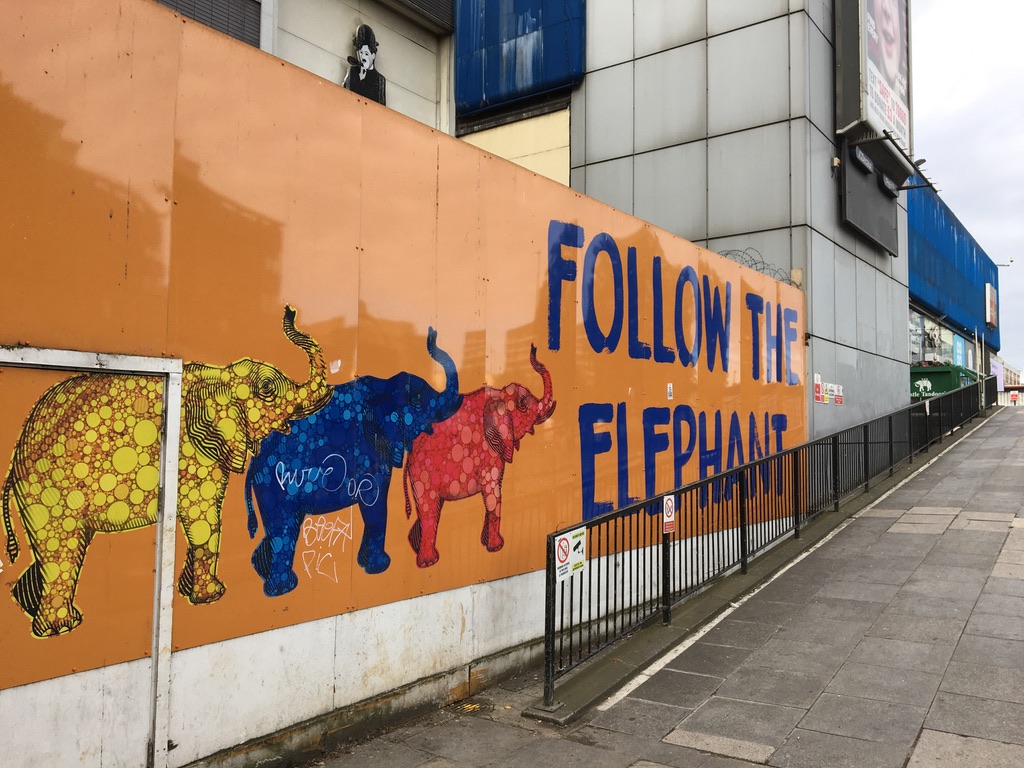
I’VE heard the Elephant and Castle called a lot of things over the years but, until now, international tourist destination had not been one of them.

But that was the verdict of a bunch of housing protestors who turned up there last week to complain about the number of flats in the neighbourhood let out through Airbnb and other short-term rental outfits.

With foreign tourists currently absent for the duration, many of the flats are emptier than usual and should be requisitioned for ordinary folk who need them, according to the campaigners.

The slightly edgy and traditionally working-class district has suffered over the years from the curse of “regeneration”, a weasel word that often serves as cover for making a profit by turfing out the locals. I’ve seen two such heralded rebirths of the Elephant in my lifetime.

It’s not so much a neighbourhood as a junction, with roads leading to Kennington, Walworth and the Borough, south to the Old Kent Road, west to Parliament and north to Blackfriars. In other words, pretty central.

In its pre-war heyday, It was nicknamed “the Piccadilly Circus of South London”, a bit of a stretch since the real thing is only three stops north on the tube.

Those were the days in which none but the most intrepid north Londoner would dream of crossing the Thames. Maybe they were scared off by the reputation of the Forty Elephants, an all-women crime syndicate of Cockney amazons who ran with the notorious Elephant and Castle gang.

I remember the old blitz-scarred Elephant from the days before its 1960s’ regeneration, with its elegant if smog-blackened stores, the back-street workshops and the mighty Trocadero, a massive 3,000-seat mock-Renaissance cinema, built in the days when such over-the-top venues were called picture palaces.

The art deco Coronet cinema opposite survived as a night club until 2018.

But the Troc went in the 60s’, along with most of the surrounding department stores and shops, to be replaced by two gigantic roundabouts and a covered shopping centre, Europe’s first mall.

The pub that gave the area its name made way for an anaemic modernist replacement.

Council flat construction continued into the 1970s and the area kept its working class flavour with the admixture of the Latino culture of the many Colombians, Peruvians and Ecuadorians who gravitated there from the 1980s, with some setting up shops, restaurants and night clubs.

Now, they and the rest of the community are threatened by the latest regeneration, which mainly consists of developers exploiting the area’s central position to build massive blocks of luxury flats.

Investors include the Qatari royal family, who seem to have taken a shine to Sarf London, having paid for the Shard just up the road.

A three-bed flat in the One The Elephant block will set you back only £1.2 million. And don’t worry if you’re a buy-to-let overseas investor – they do video-viewings.

There’s plenty of property available, particularly since the vast and uncared for 1970s Heygate council estate was bulldozed to make more room for upmarket blocks.

According to local campaigners, the Elephant is ground zero for the gentrification of London. But the high life remains very much up in the air. When the newcomers descend from their penthouses, they walk out into increasingly tatty streets.

For the Elephant is as much a victim of planning blight as of regeneration. The shopping centre was supposed to come down a decade ago but is still just about operating and looking increasingly forlorn.

Poor old cash-strapped Southwark Council now seem more in league with the developers than with the locals, gratefully accepting the promised crumb of “affordable housing” in exchange for planning permissions.

The developers have changed over the years as have their often shadowy investors. There’s really not much to show so far, apart from the luxury blocks, for a promised £3bn transformation.

Anyway, if you’re planning a trip to London when the virus settles down you could do worse than Airbnb it at the Elephant at £90 a night. You’ll be in easy reach of all the central London sights.

Just be careful on your way out. You still get the odd gang killing at a junction where the territories of rivals overlap and even the school kids can be pretty lively.

In one incident last year, two mobs of the little angels squared up to each other near the shopping mall. The police moved in, although there is no confirmation of reports they brought tasers to get the children home in time for bed.

Popping down to Peckham: Lovely Jubbly!

PECKHAM was recently named London’s coolest neighbourhood by the fun-things-to-do magazine Time Out. Some even talk of it as the Shoreditch of the South. Shoreditch!?

Strange how some of the most grimy bits of London have become the most sought after. I call it grungetrification.

Growing up as kids down the road in post-war New Cross with its tangle of railway tracks and smog-shrouded bombsites, our one consolation was that at least it wasn’t Peckham.

We always thought Peckham was a bit dodgy, long before the emergence of violent gangs such as the Peckham Boys from the 1970s.

The lighter side of the area’s shiftiness was immortalised in the TV comedy sitcom Only Fools and Horses that ran for a decade from 1981. David Jason’s character “Del Boy” Trotter runs his mainly harmless get-rich-quick scams from his council flat in Peckham.

Del Boy’s upbeat catch phrase “lovely jubbly” has since entered the vocabulary of every taxi driver and trinket-seller from Manila to Marrakesh who encounters British tourists.

There was an attempt to smarten the place up in the ‘90s, with the European Union helping to fund a swish new library. That’s when the artists and musicians and cool young professionals started moving in, swiftly followed by the cafés, wine bars and studios.

The area now has one of the most scenic rooftop bars in London on the top of a derelict multi-storey car park, a magnet for hip millennials.

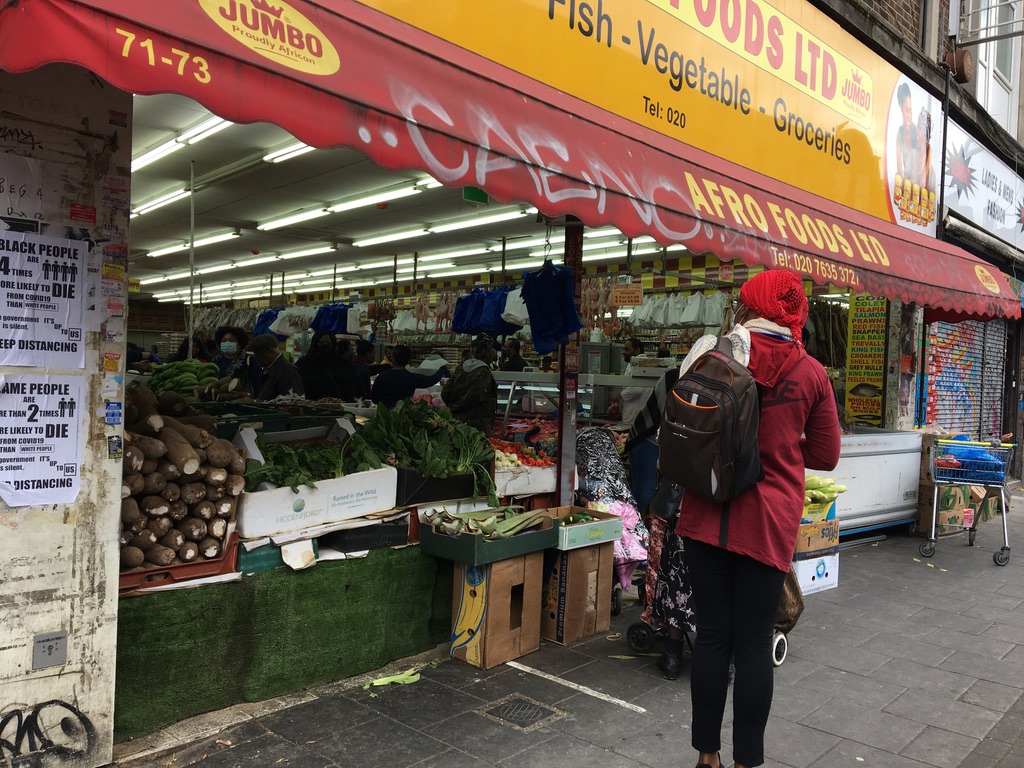
Today the main shopping street, Rye Lane, was heaving. I didn’t spot too many likely web developers or graphic artists. Most of the shoppers were from the local African, Caribbean and minority communities who make up a majority of the population of central Peckham.

There was a huge Black Lives Matter poster on the side of the award-winning library. But most of the actual black people were on the street, with long queues at the money transfer shops and the greengrocers. A fiver a pop for a yam seemed a lot to me. But what do I know? Lockdown prices?

Peckham has earned a bad rep over the years for drug-related knife crime, a phenomenon routinely associated with young black kids in the minds of those who forget the white razor-gangs of an earlier generation who fought for turf across South London.

In one of Britain’s most high-profile killings, 10-year-old Nigerian-born Damilola Taylor bled to death in the stairwell of the North Peckham Estate in 2000. Two local youths were eventually found guilty of manslaughter.

None of the above should put you off. As a TripAdviser contributor wrote in response to a tourist’s inquiry about whether it was safe: “I live in Peckham and it’s absolutely fine, yes it used to be rough but now it’s a gentrified, hipster haven with tonnes of cafes, breweries and arty rooftop bars.”

Truth to tell, there hasn’t been too much bad action in Peckham since the 2011 riots, although I do question the wisdom of Time Out’s reference to it being “a mere stone’s throw away” from Camberwell.

Let’s hope it recovers from our present difficulties and that the cool trendsetters stay on. I’ve heard whispers that some new urbanites are planning a post-Covid return to the country – work from home, plant some veg, raise some goats (just for the milk, of course).

Whatever happens though, and for good or ill, there will always be a Peckham.

But you’ll be dying now to know more about New Cross. So here’s a link to ITLW’s very first column to give you the full monty.

Post-pandemic Britain: Going to the dogs

WHAT with this year’s Brexit Independence Day, coronavirus, and the post-pandemic prospect of the United Kingdom falling apart, everyone missed the half-centenary of a defining moment in British politics.

I’m referring of course – as Londoners may already have guessed, but maybe not – to the historic 1970 unilateral declaration of independence by the Isle of Dogs.

At a time when future Brexiteers such as the one-year-old Jacob Rees-Mogg were still having their nappies changed by nanny and were yet to dream of going it alone, the islanders rejected the rule of faceless bureaucrats in the Tower Hamlets Council and struck out on their own.

For the guidance of non-Londoners, the Isle of Dogs is at the southern end of the large, scrotum-shaped peninsula formed by a meander in the Thames a couple of miles east of the City.

The favourite theory of how it got its name is that Henry VIII kept his hounds there to avoid their yapping when he was staying at Greenwich Palace on the opposite bank.

Others have claimed it was a refuge for Edward III’s greyhounds. He had a hunting lodge over the river at Rotherhithe. Some say its a corruption of the Isle of Ducks, or the Isle of Dykes, say others.

The area was a sparsely populated foothold in isolated marshland until it was drained and planted in the 13th century. Not much changed for half a millennium until the construction of the East India and West India Docks early in the 19th century and Millwall Dock towards the end of it.

With the River Lea to the east and the Thames to the south, the addition of the docks restored the area to its island status, connected to its neighbours by just a couple of raising bridges.

It was these crossing-points that the rebels seized on March 1, 1970, cutting off the Isle of Dogs from the rest of the country, before declaring independence under the leadership of President Ted Johns, a local Labour councillor. He had two prime ministers, one a lighterman and the other a stevedore.

The insurgents claimed their municipal masters had “let the island go to the dogs”. A copy of the independence declaration was dispatched to Prime Minister Harold Wilson.

Many of the island’s 10,000 residents flocked to the barricades, including women in hair curlers and kids on bikes. A Swedish cargo ship was among the vessels stranded.

The revolution had been sparked by the lack of amenities and services in the predominantly white working class enclave, which had been badly battered in the blitz.

Low-rent municipal housing had gone up post-war but there was a shortage of schools while poor transport links virtually cut the neighbourhood off from the rest of London.

Since the demise of the local Poplar Council in the municipal reforms of the 1960s, the Isle of Dogs had lost its sovereignty to Stepney and Bethnal Green to the north.

Sadly, Dogxit didn’t last long. Two weeks, in fact, by which time the President and First Lady had been interviewed by most of the world’s press.

A counter-revolutionary tendency had by that time set in and had started to whinge that dad couldn’t get to work and granny wasn’t getting her Meals-on-Wheels delivery. Maybe going it alone was not such a good idea after all. They were the Remoaners of their day.

Although independence was abandoned, President Johns had been right about most things. Within a few years, the docks and warehouses were abandoned to be replaced by the skyscrapers of Canary Wharf and luxury flats along the waterways.

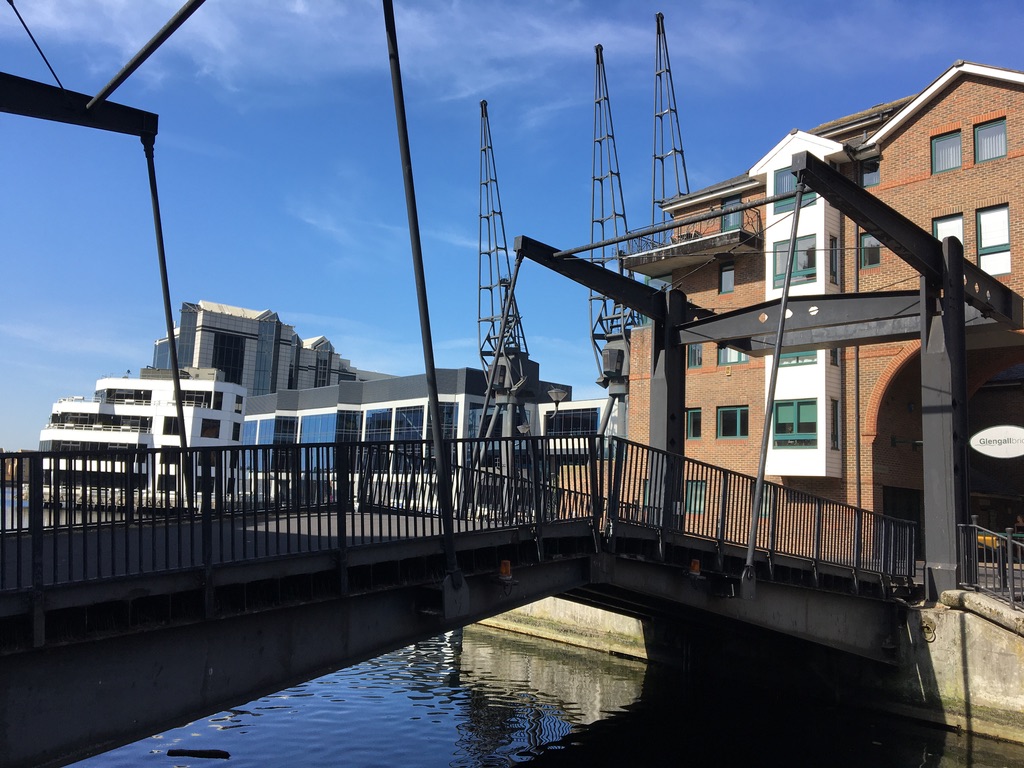
(I snapped today’s picture at the chi-chi bridge at Millwall Dock that the developers put in to replace the once-barricaded original.)

The locals got next to nothing. Many drifted firstly to the far right, which had stirred them up against displaced immigrants moving in from nearby Limehouse, and then to Essex where they were free to pursue their go-it-alone fantasies.

In retrospect, I think the islanders were on to something. With the prospect of post-Brexit Britain breaking up into its constituent parts, it might be time for UDI for London.

Together, our population is a thousand times that of the old Isle of Dogs and almost twice that of Scotland. If the Jocks can go it alone, why not us?

So, raise the bridges! Man the barricades! Put your curlers in! If the Isle of Dogs could do it, so can we!

CoronArona: Back on the graveyard shift

NOW, I know what you’re going to say. “Not another sodding graveyard!”

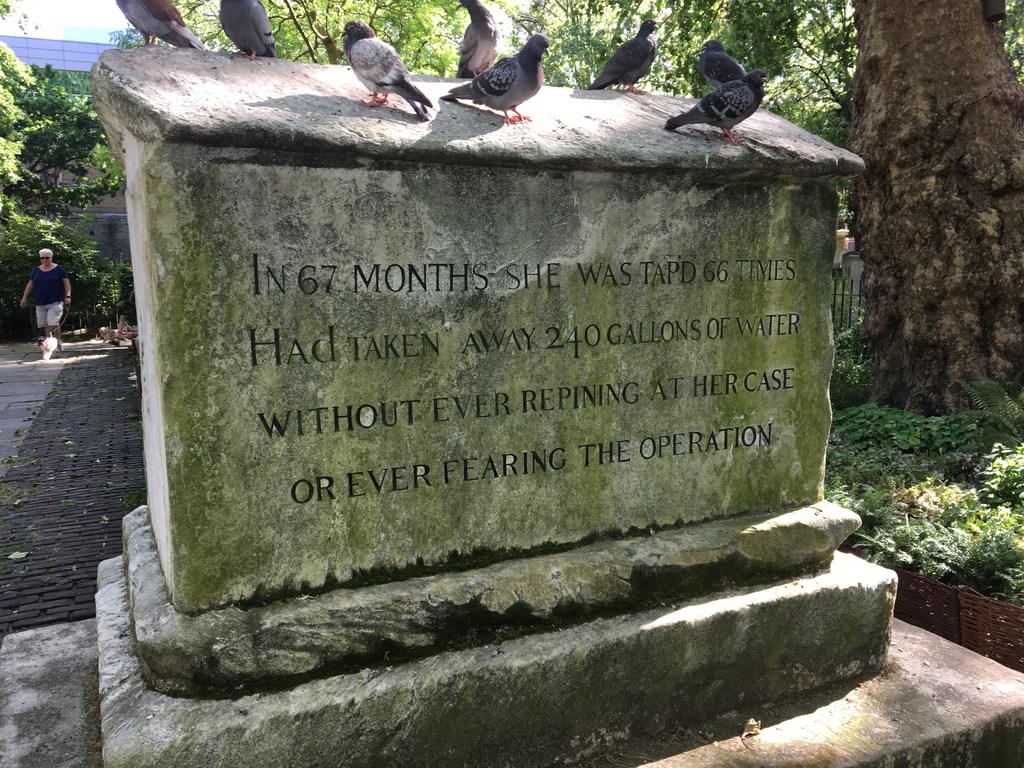
But before you pass judgment, please consider that today’s necropolis at Bunhill Fields is an entirely different kettle of corpses from the spooky Hawksmoor graveyards we have visited thus far.

Whereas Hawksmoor’s Christ Church Spitalfields and St-George-in-the-East were the final resting places of Anglican worthies from the 17th century on, the Bun hosts the remains of the literary punk rockers of their age – John Bunyan, Daniel Defoe, William Blake.

In any case, while everyone else flocks to the nearest patch of grass as the lockdown eases, London’s graveyards remain relatively empty. You can socially distance on the benches at Bunhill Fields while swapping gossip, fags and a bottle of wine. This is guidance, not an instruction.

I have a particular affinity with this graveyard, just north of the City boundary, because it was just next door in City Road that in 1986 we launched The Independent, the last glorious gasp of broadsheet journalism before the present informational darkness fell.

Before the paper launched, we all trooped down to have our picture taken next to Defoe’s tomb. The 17th-18th century writer, journalist, Robinson Crusoe author and spy was the avatar of our forthcoming endeavour.

The bunch of post-Fleet Street misfits who flocked to the new and as yet unproven title liked to think they were in the mould of the non-conformists buried at Bunhill Fields.

The paper was a startling success, based on the formula of finding out what had happened, when, where and to whom – even why if you were lucky – and printing it in the paper.

Sadly, the world is now further from that era than we, at the time, were from Defoe’s.

Truth is now a malleable concept to be moulded according to the interests of those who control the narrative. So, who would want to be a journalist these days? Glued to your screen, chewing a lunchtime sandwich at your desk – lunchtime beers went out with the last millennium – only to be rewarded by the threats and opprobrium of the Twitterati?

It was never well-paid, and now it’s worse. You can earn four and five times the dosh in PR or as a consultant or, if you’re a complete failure at it, you can always get hired as prime minister.

Journalists are designated as key workers in the current coronavirus crisis. But, if they were waiting for applause on the doorstep every Thursday night, they will have been disappointed.

You may agree with those who argue that, in a time of crisis, the last thing we need is fact-checking obsessives disrupting the official narrative. As Boris Johnson has said, re: the Dominic Cummings’ furore, “Let’s move on.”

The Guardian and Mirror journalists who spent seven weeks meticulously assembling the evidence to show that Johnson’s top adviser was, indeed, a hypocritical twat, are right to feel aggrieved that many think the media, not the politicians, are the problem.

They must be thinking: “What’s the point?”

I feel their pain.

I had a connection with Bunhill Fields long before the era of The Independent. In the 60s, I worked as a packer-checker just across from the graveyard. The job was with a company that provided work for the disabled, assembling basic home electronic components – switches, plugs, valves.

My job, alongside a wandering American, Tom, was to unpack each consignment and check one-in-ten components to ensure they met specifications, then seal them up and send them on.

Weeks went by until the day I unwrapped a box of plugs to discover that the one I selected had the connecting wires misplaced.

“Tom! Tom! Look at this!”

“Eureka! Show it to Flo’,” he said.

We carefully carried the offending plug to the forewoman. She poked, she peered, she turned and twisted it. “Find any more like this?” she asked. “Not yet!” say I.

“Stick it back in the box, darling, and seal it up. No one’ll ever know.”

It was the day I learned, thanks to Flo’, that work, as opposed to play, is invariably completely pointless.

Dodging the lockdown: Something fishy at No.10

I HAVE so far stood aloof from the Cummings affair, aware that any intervention from me could be a tipping point in the the government’s struggle to contain a national crisis of confidence.

Now that Cummings has had his say, I feel free to renounce my vow of silence.

For overseas readers, and for those who might have been in a coma for the last three days, I should explain that the scandal involves Dominic Cummings, Boris Johnson’s top aide, and his decision to flee London in the midst of the coronavirus lockdown.

Johnson has stood by his man, saying Dom was in full compliance with government guidance to “follow his instincts” by decamping from the capital for the distant pastures of his parents’ estate in County Durham.

The Cummster drove the 260 miles with his already Covid-infected wife and their young son in order to have family child care on hand in case he too should succumb.

I think the government missed a trick when it issued its “stay at home” instructions at the start of the lockdown. It should have made crystal clear that the rule did not apply to those whose relatives had provincial properties with separate living accommodation in ample grounds.

In that way, it would have been obvious that such individuals were free to sacrifice themselves by travelling long distances in order to free up the hard-pressed care and charity sectors to look to the needs of all the other self-confining parents.

Cummings, of course, is a big believer in socialised health care for all, having invented the “£350 million a week for the NHS” slogan on the side of Johnson’s Brexit battle bus to proclaim just one of the benefits of leaving the European Union.

He last appeared briefly in these columns on March 31, some days after he was seen scurrying around the back of Downing Street.

As I wrote at the time, Johnson’s apostle of “weirdos and misfits” in government is a self-declared disrupter who would like to sweep away the messy compromises of the state.

With his trademark care-in-the-community woolly hat, crumpled T-shirt and torn jeans, he has brought a breath of fresh air to the stuffy corridors of Westminster.

These very accoutrements may, however, have risked his downfall as they made him easily spottable by the eagle-eyed public of County Durham.

Happily the usual suspects have risen to his defence. His techno-libertarian friends have denounced the Gestapo mentality of the curtain-twitching general public who snitched to the police about his whereabouts.

Notable among them has been online magazine Spiked, which moved to the looney right after emerging from the ashes of Living Marxism, journal of the Revolutionary Communist Party.

Most of the old gang are still onboard and are therefore well equipped to tell us of the perils of informers and the police state.

Editor and former Troskyist Brendan O’Neill, an old RCP hand, opined that bending the rules like Cummings was one of the “wonderful buds of human rebellion in this dystopia we find ourselves in”.

“It isn’t Cummings who should be ashamed – it’s the shutdown Stalinists who are calling for his head because he dared to visit his folks.”

Brendan’s view appears to be that, if Dom wasn’t entirely in favour of a strict lockdown, he was entirely free to ignore its strictures.

It’s a point of view, but one that may not cut Dom much slack in the face of the anger of much of the country’s clearly Stalinist public that is indeed calling for his head.

Footnote: Today’s column was to have been a virtual tour of London’s original Billingsgate Fish Market. I fear that adventure will now have to await another day. I know many of you will be disappointed, but I took today’s full-colour panaroma of its fish-adorned facade, just to whet your appetites.

Graveyard cheers to a looser lockdown

THE graveyard at Hawksmoor’s St George-in-the-East is a dark place even in the spring sunshine.

Does the darkness come from the shade of the trees obscuring the faded headstones and concealing the presence of its solitary denizens? Or is it the shadow cast by the Radcliffe Highway Murders?

It was more solitary than usual this week. None of the usual winos, unless you count an old colleague and I sharing a spot of white to celebrate the easing of the lockdown.

There was a young woman incongruously sunbathing in a bikini and an older, larger one yelling “Come ‘ere, Porky” at her arthritic Staffordshire cross. Or was it Pikey? Certainly not Perky by the look of him.

The architectural critic Ian Nairn came here some years after the war to see the blitz-damaged 18th century church at a time when Wapping to the south was still dominated by the London docks and Whitechapel to the north by the gangster Kray twins.

“This is probably the hardest building to describe in London,” wrote Nairn. “This is a stage somewhere beyond fantasy…it is the more-than-real world of the drug addict’s dream.”

The church and its expansive grounds occupy part of what is still a faded boundary corridor barely touched by the East End gentrifiers.

At the time of the notorious murders in December 1811, the area was a squalid mix of overcrowded tenements, workshops and seamen’s lodging houses with a violent reputation even by the standards of early-19th century London.

The brutal slaughter of two families, 12 days apart and both within sight of the church, nevertheless sparked a moral panic, not only in the capital but across the country, spurred by the ghoulish reports in the emerging penny press.

The furore reached the highest in the land, from the newly-installed Prince Regent to the Tory government of the day. It was one factor in the eventual establishment of a professional police force to replace the elderly and often drunken watchmen who were supposed to keep the peace in areas such as the Highway.

The victims of the first attack on December 7 were Timothy Marr, a prosperous linen draper, his wife, their baby boy and the shop apprentice. Their bloody corpses were discovered by a maidservant, who had been sent out for oysters. Their skulls had been caved in with a chisel and hammer abandoned at the scene.

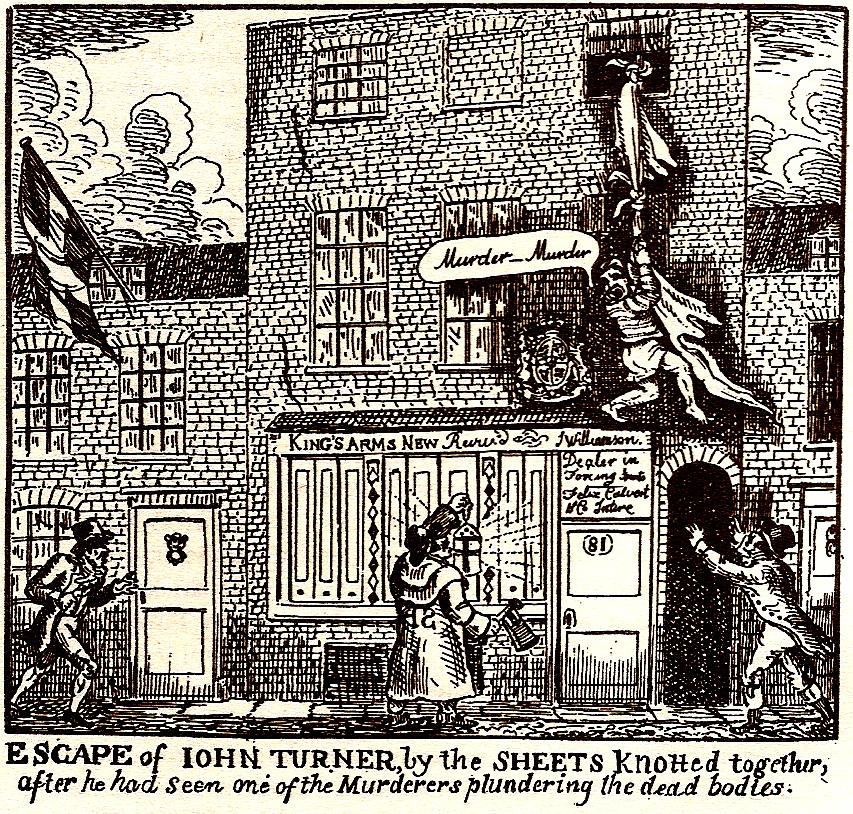
Then on December 19, a man was seen lowering himself by a sheet from the upper floor of the King’s Arms tavern, crying: “They are murdering people in the house.”

A constable and neighbours broke in to find the bodies of the 72-year-old landlord and his wife, both with their throats cut, and the mutilated corpse of a servant girl. A crowbar was found at the dead man’s side.

A hue and cry soon went up that a gang of foreign seamen must be responsible, specifically the Portuguese. The government was urged to post a proclamation from the Regent to be published locally in Portuguese and “oriental languages”. Three Portuguese were arrested but subsequently released after the intervention of their London consul.

Next, it was the turn of the Irish, widely suspected in the neighbourhood of having carried out the killings as part of a papist plot.

After a series of arrests, and following a tip-off from a Dane, suspicion fell on John Williams, a Scot. But, on December 27, before he could be committed for trial, he cheated the hangman by doing the job himself in his jail cell.

Although Williams’ guilt was never proven, the case was closed. In a judicial first for England, the authorities pandered to the outrage of the locals by having Williams’ corpse paraded past the scenes of his alleged crimes on the back of a cart. Some 180,000 people turned out to see him.

His body was dumped in an unmarked grave at the corner of St George’s graveyard.

Half a century later, workmen accidentally dug up his skelton along with the stake that had been posthumously thrust through his heart to prevent his spirit wandering.

Reflecting on his fate, Thomas de Quincy, of Confessions of an English Opium-eater fame, noted ironically that the murders were “the sublimest and most entire in their excellence”.

The killings were “amongst the few domestic events which, by the depth and expansion of horror attending them, had risen to the dignity of a national interest.”

Happy walking!

Post-lockdown: Wether to stay or Wether to go

IT’S all about risk.

As the British government prepares to reopen schools as part of its proposed easing of the Covid-19 lockdown, parents and teachers’ unions are naturally concerned about the threat of exposure to infection.

The outcome of the debate will provide valuable lessons on how we cope with another looming dilemma: when will it be safe to send our old people back to Wetherspoons?

For the uninitiated, Wetherspoons is a chain of some 900 pubs run by multi-millionaire man-of-the-people Tim Martin and patronised by, among others, solitary seniors who enjoy a cheap breakfast pint with their morning fry-up.

If you have an old person locked down at home, you’ll understand the toll self-isolation can have on mental health – yours if not theirs.

Better surely, despite the health risks, to have them back in the local Wetherspoons where they can reminisce with their contemporaries about “Two World Wars and One World Cup” or lament the imminent Muslim takeover of Britain.

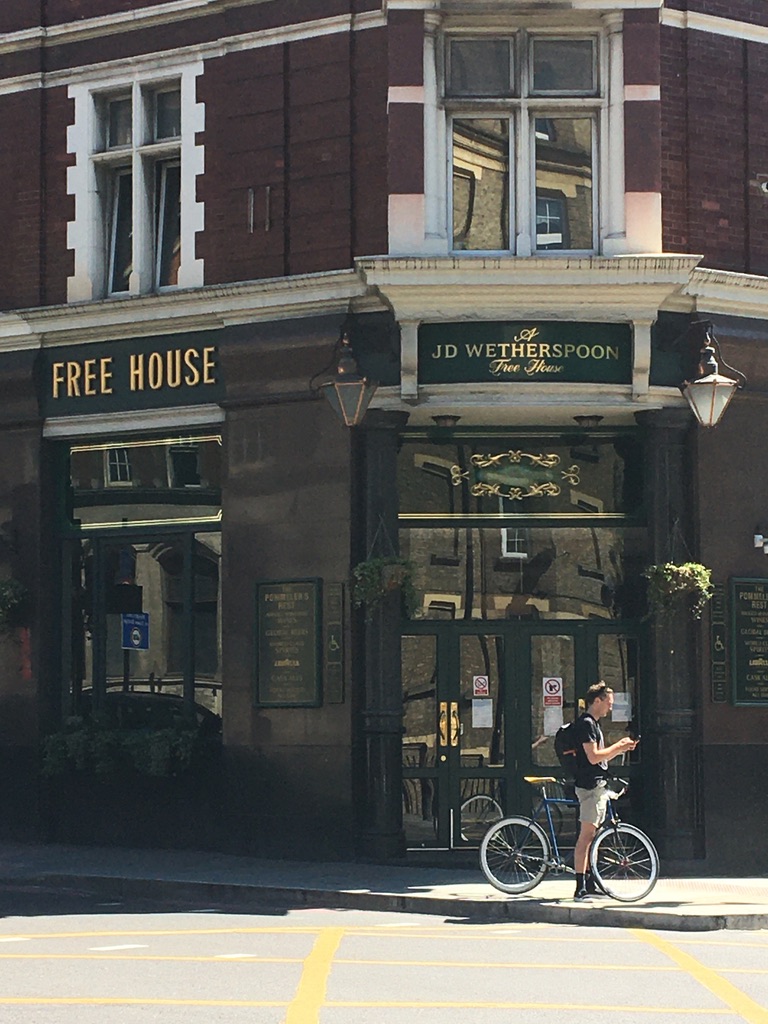
Our local Wetherspoons, The Pommelers Rest, has been bolted and abandoned since the lockdown closed pubs on March 23, despite Tim’s argument that: “There’s hardly been any transmission of the virus within pubs, and I think it’s over the top to shut them.”

Nevertheless, Tim bit the lockdown bullet, assuring his 40,000 staff that, since he didn’t plan to carry on paying them, they could probably get jobs at their local supermarket.

With some pubs due to reopen as early as July, it’s already time to consider whether to keep your wrinklies close or send them back to The Pommelers.

There will always be a risk. However, given that one-in-three over-65s has a nasty fall at least once a year – some of them by just getting out of bed – the local Wetherspoons may actually provide a ‘safe space’.

Flexible opening hours mean you can pack them off at nine in the morning and leave them there until midnight under the watchful gaze of geriatric-trained bar staff. The cleaners start vacuuming Tim’s custom-woven carpets at around 10.30PM, so there’s no risk of your elderly loved-ones sleeping through last orders.

No option is risk-free. Even before the lockdown, Tim’s customers were exposed to pro-Brexit beer mats that warned, inter alia, that: “If the unelected President Juncker and his apparatchiks continue to be obstructive, remember that all EU products can be replaced by similar alternatives from the UK – or from the 93 per cent of the world not in the EU.”

The New Zealand-educated Britain Firster is a man of his word. He announced more than a year ago that wines from France, Italy and Germany were being removed from his pubs, along with a third of draught beers from the European Union.

“By choosing British beer and looking out for the British hops logo on your pint, beer drinkers can actively support businesses close to home.” Well said, Tim. As long as you can find a Romanian to pick them.

Sadly, by the time of the lockdown, the message had yet to filter down to his largely immigrant staff. The Turk at the Pommelers was dealing foreign booze across the bar right up to the last minute.

As the “Wetherspoons or not” debate looms, I must declare a personal interest. I not only belong to a vulnerable age group, I also suffer from an underlying condition – the inability of my aged companions to find their wallets as they stagger to the bar.

I suggested to my in-house carer that I could cover myself by standing the first round as soon as The Pommelers reopens. Her response: “You must be f***ing joking. Shut up and stay indoors!”