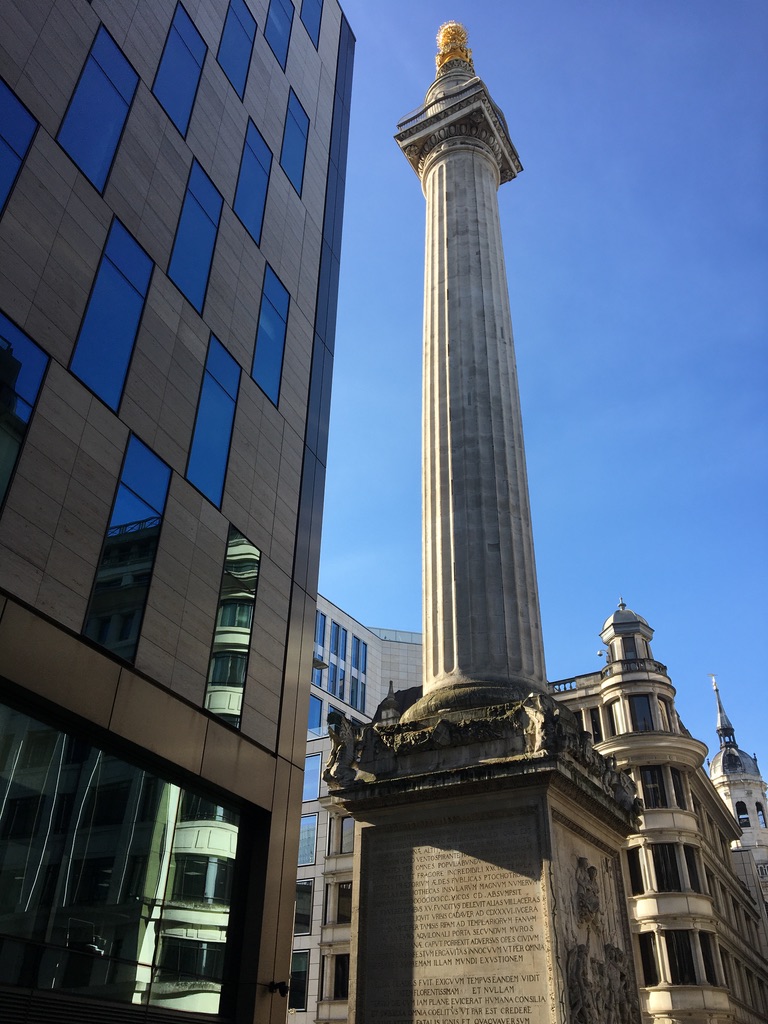
I’M not sure I’ve ever climbed to the top of the Monument and there was no chance of rectifying that today as, like all London’s public attractions, it has been shut down for the duration.
The 202-feet column, topped with a flaming copper urn, was set up in 1677 to mark the rebuilding of London after the Great Fire of 1666 that broke out near the site at Pudding Lane.
The Great Fire was something of a good news, bad news event. It destroyed 90 per cent of the city but it also cleared the web of medieval slums that had been a breeding ground for the Great Plague of the previous year.
There were only six verified deaths in the Fire, less than the number who have since plunged to their deaths from the monument that commemorates it.
During the Plague, the diarist Samuel Pepys wrote of how he overcome a panic attack when he left self-isolation to take a walk in fetid Drury Lane. “It put me into an ill-conception of myself and my smell, so that I was forced to buy some roll-tobacco to smell and to chaw, which took away the apprehension.”
Carry on smoking, then.
The Monument to the Great Fire hardly rates as one of London’s top tourist attractions. It’s tucked away in a square at the north side of London Bridge. It was completed just 28 years after the English had chopped off the head of their king, Charles I, and 17 years after the monarchy’s restoration.
In the still febrile politics of the post-Civil War years, both the Plague and the Fire provided ample opportunities for conspiracy theories. In those days, the targets of the fake news that spread among the good burghers of Protestant London tended to be foreigners and Catholics.
In the years after the Monument was erected, England was embroiled in the so-called Popish Plot, an entirely fictional conspiracy theory about Catholics plotting to assassinate King Charles II.
In 1681, the keepers of the Monument added to its Latin inscriptions recording the events of the Great Fire: “But Popish frenzy, which wrought such horrors, is not yet quenched”. They were deleted in 1830.
In those days, fake news was chiselled in stone rather than Tweeted out.
The Monument was designed in consultation with Sir Christopher Wren, who rebuilt St Paul’s cathedral but failed to push through his plans for a new city of broad, straight avenues and open spaces.
Freeholders insisted on rebuilding according to the medieval street pattern of the City. That’s why it remains a patchwork of narrow lanes and why original names such as Pudding Lane and Fish Street Hill have survived.
Well, that’s enough history for one day. But before I sign off, just a word about joggers.
Has the government given them a special dispensation to ignore the two-metre social distancing rule as they wheeze and cough their way around the near deserted streets of London?
Unwilling to divert from the set trajectory of their daily power runs, they either come up behind you or advance towards you under the assumption that it’s up to us mere pedestrians to get out of the way.
Even the cyclists are behaving better these days. Joggers, however, have now replaced the absent seagulls as London’s new feral menace.
Footnote: yes, I know about Johnson. And I hope he, and everyone else, gets well soon.
 Idle Thoughts on London Walks
Here in deep southern French countryside, as we escape lockdown on our daily walk, rarely seeing another soul apart from goats, we have been overtaken by a grunting jogger who, until the moment he passes us is completely silent, scaring the wits out of us. Even here feral joggers seem to have a dispensation to ignore the rules.
LikeLike