NO jokes today, as the topic is the National Health Service. As we all acknowledge, the NHS is like a religion in Britain, so I want no giggling in the back pews.
Like conventional religion, we tend to turn to it at times of trial and tribulation and pledge to put another fiver in the collection plate.
There is no doubting Boris Johnson’s sincerity after he rose Lazarus-like from intensive care, praising his bedside watchers Saint Jenny and Saint Luis and the host of ministering angels.
Unlike the taciturn Lazarus, born-again Boris rose from the near-dead to volubly proclaim: “We are making progress in this national battle because the British public formed a human shield around this country’s greatest national asset – our National Health Service.”
Funny, that. For the last decade, successive governments have been gnawing away at the NHS like woodworm in a cathedral roof. The rot in the rafters set in well before that on the back of Margaret Thatcher’s “no such thing as society” nonsense.
Her disciples preach that we should learn to stand on our own two feet, until the day they break an ankle and then it’s straight round to the state-funded A&E.
It’s not just the NHS that has suffered in four decades of market forces, “rationalisation” and creeping privatisation. Many of the welfare state reforms brought in by Labour’s near-skint post-war government have fallen by the wayside.
The journalist Stuart Maconie provides a catalogue of what’s been whittled down in his new book “The Nanny State Made Me” – public libraries and youth clubs, concert halls and council housing, parks and public transport, local authority schools and free college tuition, even municipal golf courses. And, of course, the NHS.
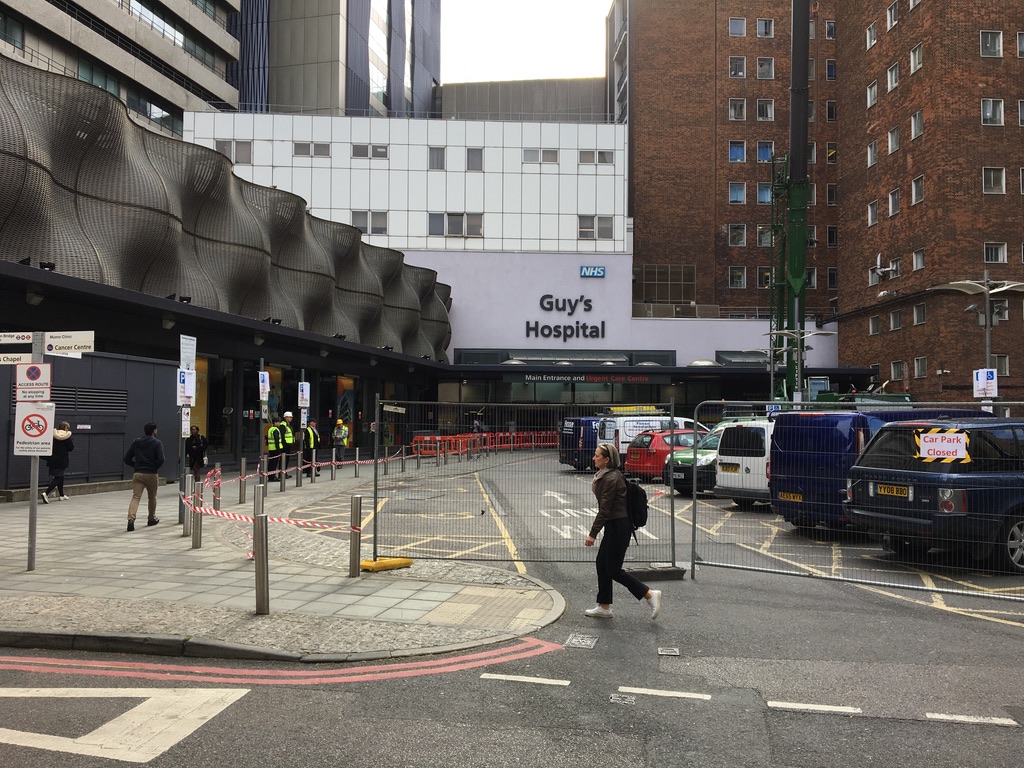
Some health services have been “consolidated”. The A&E at Guy’s (see today’s picture) has moved to St Thomas’s, where Johnson was treated. The hospital at Lewisham was saved only after a lengthy public campaign backed by Millwall fans (see Idle Thoughts passim).
Maconie’s book came out in that narrow window between Johnson’s election victory in December and the emergence of coronavirus.
He notes that the dismissive “Nanny state” label is a particular favourite among that tiny minority, such as Jacob Rees-Mogg, who actually had a nanny!
“Working class people, in fact most people,” he writes, “the many not the few, have neither sneering contempt nor quivering fear of the nanny state.”
Maconie’s subtitle is: “A story of Britain and how to save it,” particularly relevant right now as we hunker at home, with many worrying how they will survive a looming recession in which their jobs may be gone forever.
Johnson’s government has pledged gazillions to keep everyone going as we confront the crisis, although many complain that the promised dosh is taking a while to come through.
On the day after, will the government replenish the NHS’s collection plate? Now that the scales have fallen from Johnson’s eyes, will he and his big-spender cabinet converts attempt to turn back the clock on government cuts to the nanny state that made us?
Don’t hold your breath.
 Idle Thoughts on London Walks
I think there was a slip of the tongue by Boris. When he said the public formed a human shield around this country’s greatest asset, I am sure he was referring to himself not the NHS.
LikeLike
Think you might be right!
LikeLike
I’m sure you’re right!
LikeLike