FLEET Street is a pale reminder of its former newspaper-era glory. Nowadays it’s just another street, with the City at one end and the West End at the other. Under the coronavirus lockdown it’s more lifeless than usual.
The glass-fronted art deco building at number 120, formerly the Daily Express’s “Black Lubyanka”, today looked not so much shut as abandoned.
There was a time when the front door never closed. Ditto at the Reuters building opposite, or at The Telegraph up the road, or all the other news organisations that had lined London’s Inky Way since the scribblers first moved there more than 300 years ago.
Until the 1980s, there was a 24/7 jostle of journalists, printers, copyboys, messengers. Newsprint trucks and paper delivery vans choked the side streets and buildings shook from the rumble of the presses.
That Fleet Street has been dead for a generation. And it wasn’t a virus that killed it, unless you count Rupert Murdoch. He started the exodus from Fleet Street in 1986 when he moved his Sun and Times titles east to Wapping to end an epic battle with the print unions. The printers were all sacked.
Other owners followed the trend and newspaper offices were scattered around the capital. It took another 30 years for Fleet Street to be officially declared dead when Scotland’s Sunday Post closed its London office in 2016.
I remember walking past the Express building when I was about 14. A film crew had pasted masking tape across the Streamline Moderne frontage to simulate cracks. It was the location for the 1961 film drama, The Day the Earth Caught Fire, in which the Express’s archetypal Fleet Street editor, Arthur Chistiansen, played himself.
Arthur assigns two of his top men to investigate the crisis provoked by the earth being knocked off its axis, threatening to incinerate the planet.
They did what any self-respecting hacks of the time would have done. They went straight to the pub.
Pub culture was very much part of the old Fleet Street. Four pints and a sausage roll was the usual fare for lunch and a livener or three would lubricate consultations into the evening and beyond.
It only occasionally got out of hand. My friend and colleague the late, legendary Ron Thomson, used to boast that he was once fined a tenner by the Bow Street magistrates for an offence described by the arresting constable as “staggerin’ in the Strand”.
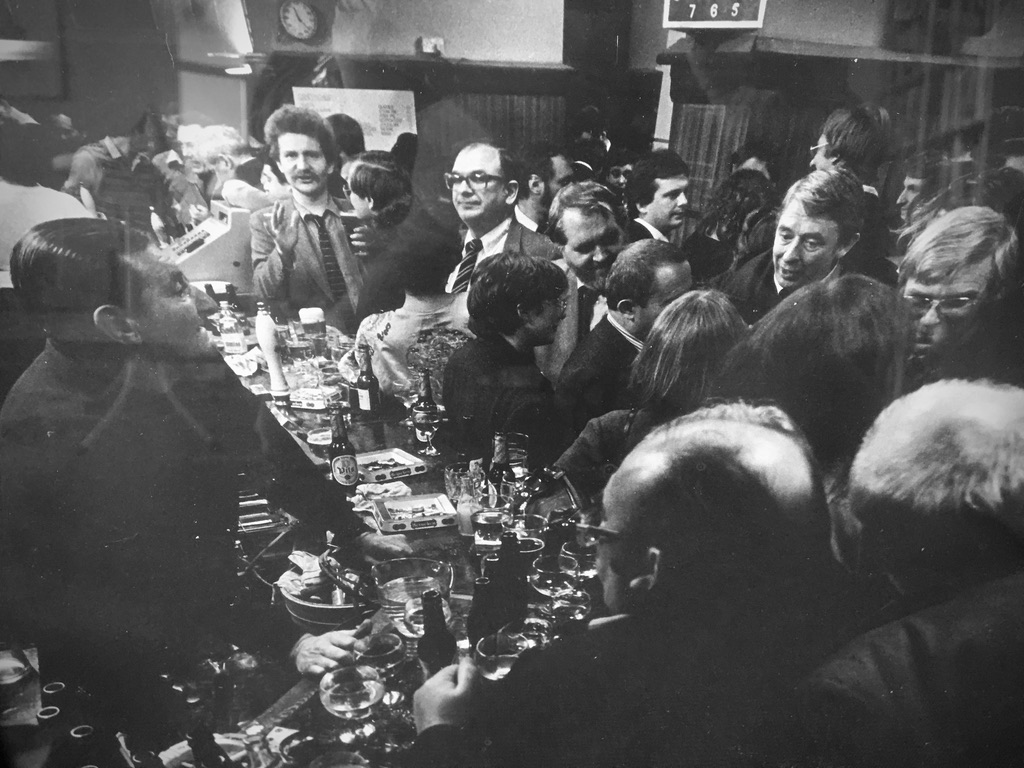
Each outfit had its favoured bolthole. In my Reuters days, it was a cellar bar we nicknamed Mrs Moon’s after the slight but intimidating harridan who ran it. The bar had somehow been overlooked when the developers shut the Falstaff pub upstairs.
Mrs M ran a tight ship alongside son Billy, a tall, bespectacled and intimidating Millwall fan, Bill the barman, an ex-merchant seaman, and the lunch lady Armpit Lil who would wipe away the sweat with the kitchen teatowel if she got overheated.
(Today’s picture is of closing time in the mid-‘80s. I’m centre-left, looking towards the camera as I make an important point. Ron is the Scottish slaphead at bottom second right.)
It’s easy to romanticise the good old days before the era of clickbait and Twitter in which everyone seems to think he or she is a journalist or influencer or whatever. People who would have trouble composing a coherent thank you letter to their granny daily denounce the Mainstream Media.
Journalism has certainly changed. In the old days, before the advent of media studies, kids would enter straight from school and do an underpaid three-year apprenticeship before being let loose on the reading public.
That said, the modern generation still try to keep up traditional standards of accuracy and sourcing.
In that tradition, the Sunday Times and Financial Times recently exposed some of the ineptitude of the government in its tackling of the coronavirus crisis. Whitehall responded, using rather more words than the offending articles, with obfuscating replies. PR Week judged the government’s response “long and rambling”.
Some of the usual suspects in the Twittersphere think the media should now be standing foursquare behind the government as it confronts its own version of the D-Day landings.
But, as in Christiansen’s and Thomson’s day, the role of the press is not to pat officials on the shoulder for a job well done but to constantly press them for straight answers.
The old Fleet Street may have gone, but the principles that guided the best of it hopefully live on.
 Idle Thoughts on London Walks
I enjoyed your column about Fleet Street, Harvey. Forty years after I worked at RWS (1974-77) and returned to Australia memories of my colleagues are hazy but I remembered you instantly with that head of fuzzy hair in the picture at Mrs Moons. I visited Fleet Street a couple of years ago and felt sad to find so little evidence of its heydays. As you point out, the same could be said for much of journalism itself in the on-line era. Thanks in part to my priceless experience at Reuter, I’m so old school I’d be unemployable if I wasn’t already employing myself! Kind regards.
LikeLike
Hi Chris. Hope you’re doing well. I often think some of our most talented but eccentric colleagues would always have been unemployable in any other field. Take care.
LikeLike
I remember Mrs Moons it was fun but quite scruffy, if not dankish, certainly basic, wasn’t it?
LikeLike
Scruffy is putting it really, really politely
LikeLike
Thank you, Harvey. Four pints and a sausage roll for lunch and I think it was Young’s in there, wasn’t it? I favoured the Dive Bar when at the Mail. I always assumed it was one of the bars in Michael Frayne’s novel Towards the End of the Morning. I hope you are well.
LikeLike
Thanks, John. I always thought Towards the End of the Morning should be read as non-fiction! Stay well.
LikeLiked by 1 person