THERE is no way I am going to get involved in the culture wars over the fate of the nation’s statuary. You will all have your own opinions about whether slave trader Edward Colston belongs on a pedestal or at the bottom of the Bristol Channel.
However, the current kerfuffle over which monuments should stay and which should go does raise one interesting question: who decides in the first place who gets a statue?
Such choices are often controversial and they are not made overnight. Churchill didn’t get his statue in Parliament Square until 28 years after Victory in Europe and Margaret Thatcher didn’t get one at all.
Westminster Council rejected a Thatcher monument on the grounds it was likely to be a magnet for protestors. The bronze was shuttled off to Grantham where, even in her provincial birthplace, police warned it could become “a target for politically-motivated vandals”.
The authorities appear to have had no such qualms in the case of Sir Simon Milton, the most memorialised man in London.
“Sir Simon Who?” I hear you cry. It’s certainly true that, as someone who merits not one but five memorials in the city, as well as a plaque and a square in Victoria named after him, he remains a relative unknown to most of us.
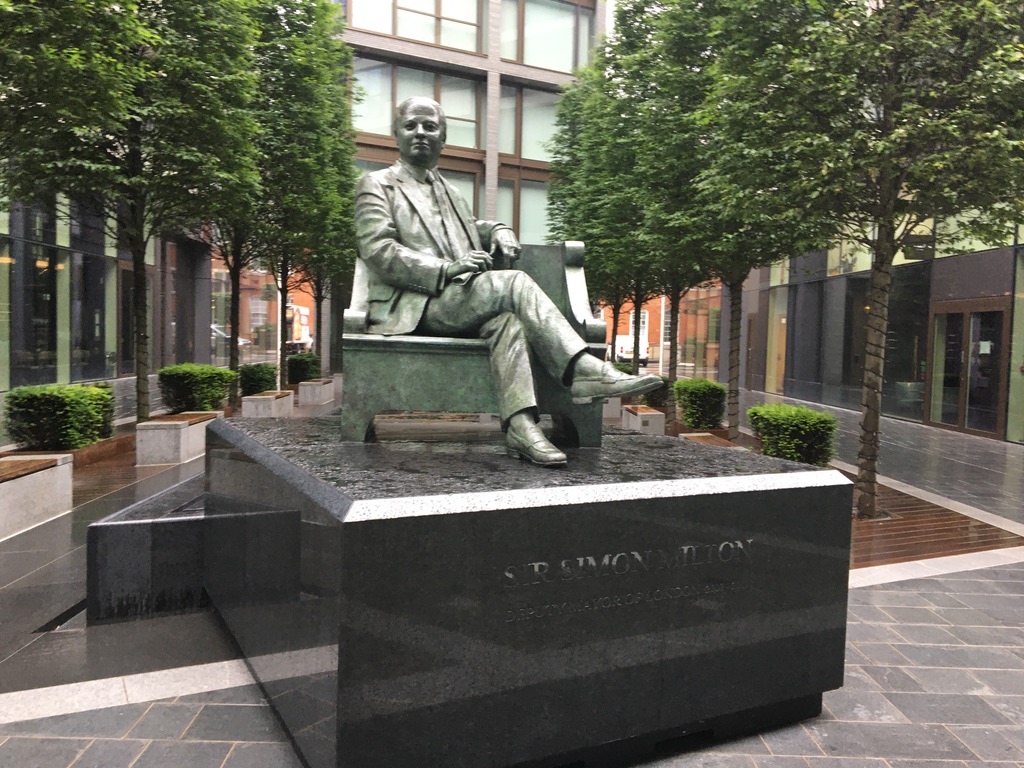
The tributes include a statue in the Sir Simon Milton Memorial Garden in Paddington, a bust in Piccadilly and, most recently, a larger-than-life seated figure near City Hall at the southwest corner of Tower Bridge (today’s picture).
It sits in the quadrangle of the new, unsightly luxury development that houses the Bridge Theatre. It was originally on the walkway outside, where it got in everyone’s away.
So who was Sir S and why such a monumental fuss?
Raised in north London, he was a Conservative councillor and subsequently leader of Westminster City Council until 2008. He had been director of a lobbying firm embroiled in Parliament’s cash-for-questions scandal.
When he was a simple councillor, a predecessor as leader, Lady Porter, did a runner after Westminster was accused of gerrymandering in a homes-for-votes scandal that involved selectively selling off council houses to those more likely to vote Conservative.
But Milton’s biggest claim to fame was that he served as Boris Johnson’s deputy and chief adviser when the current prime minister was mayor of London from 2008. He was the brains behind the bluster and Johnson returned the favour by unveiling his City Hall statue in 2016.
He was to Johnson then what the lockdown-dodging Dominic Cummings is today.
Milton died in 2011 at the sadly premature age of 49.
So why all the statues? The Tory website Guido Fawkes archly remarked that it surely had nothing to do with the fact that Milton’s longtime companion and civil partner, Robert Davis, had been in charge of planning at Westminster Council.
Davis, a former Lord Mayor of Westminster, stepped down as the council’s deputy leader in 2018 after he was found to have accepted hospitality and gifts on more than 500 occasions, most of it from property developers.
During his time as a planner, Davis removed five busts of the likes of Sir Isaac Newton and satirist William Hogarth during an ugly and mindless £15 million remake of Leicester Square.
At least there’s room now for a Boris bronze or even a discreet Cummings cartouche.
 Idle Thoughts on London Walks
Surely time for Robert Davis to get his own bust in Leicester Square for services to urban hooliganism?
LikeLike
Leicester Square remake was an outrage. I hadn’t known before that he was the guilty man.
LikeLike
Time for a few strong fellow to help Mr Davis`s likeness to be sleep with such fishlife as remains in the Thaimes
LikeLike
Correction: Time for a few strong fellows to help Mr Davis`s likeness to sleep with such fishlife as remains in the Thames
LikeLike