FELLOW idle walkers will confirm that yet another lockdown has tended to confine us to our cruising areas, in my case the urban wonderland that is inner southeast London.
Fortunately, there are still plenty of diverse bits of the capital easily accessible from that particular safety zone, including my latest destination – Whitechapel.
It’s an area that is both sinister and exotic, particularly if you’ve crossed over from the Other Side.
This corner of the old East End owes the former reputation in part to the activities of a late 19th century serial killer, immortalised in the name of a local fried fish shop on Whitechapel High Street, Jack the Chipper.
A couple of decades earlier, Joseph Merrick, the severely deformed Elephant Man, had been put on display at a freak show in the back of a shop in the Whitechapel Road.
An even darker stain on the area’s rep is its association with the Krays, the murderous twins who ran organised crime in the East End in the 50s and 60s.
It was at Whitechapel’s Blind Beggar pub in 1966 that Ronnie Kray shot and killed George Cornell, a hood with the rival south London Richardson gang.
The refurbished pub now punts itself as “the most famous pub in Great Britain”. And we all know why, don’t we?
One of the most dispiriting things about London folklore is that it so often gives pride of place to psychopathic gangsters like the Krays and the Richardsons, both the subjects of endless films and documentaries, though mercifully with time the undeserved glamour is fading.
There was a time when nearly every bloke who’d done National Service in the early 50s claimed to have been in the same unit as the Krays (the twins spent most of their service in the glasshouse), while every dustman in south London would insist he had emptied the Richardsons’ bins.
The brothers hung out with aristos and stars in the West End until their inevitable comeuppance.
At the same time as they were rampaging around Whitechapel, the area became the focus of an explosion of London Jewish literary talent with works by Arnold Wesker, Wolf Mankowitz, Bernard Kops, and Lionel Bart, the creator of Oliver!
Mankowitz’s gentle, Whitechapel-set novel A Kid for Two Farthings was made into a film in 1955 starring, among others, the excellent Diana Dors. The 50s’ blonde bombshell was one of the Krays’ coterie of West End showbiz friends.
(At around that time, Mankowitz and his wife would often cross the river to have a sit-down fish supper at our shop in New Cross, declaring it the city’s finest and thereby no doubt inviting the wrath of Jack the Chipper.)
The era of Jewish Whitechapel was by then past its heyday. Many of the community’s workers and small businessmen, who had dominated the area’s markets and rag trade, had moved on to north London or to Israel.
Bloom’s kosher restaurant survived until 1996. The self-employed waiters there earned their living by buying the meals from the kitchen and selling them at a profit to the diners, hence the commendable rapidity of the service.
The latest newcomers were immigrants from the Indian sub-continent, mainly Bangladeshis. They and their descendants are known back home as the Londoni.
The latest flavour of Whitechapel, a focus for immigration over the centuries, is now south Asian and Muslim, with religious life focused on the East London Mosque. During the ISIS crisis, there was much media jumping up and down about the mosque, opened in 1985, being a focus for radicalisation. The mosque vigorously denied it.
In any event, most of Whitechapel’s peaceable Muslim stallholders and market traders are presently more focused on keeping business going in the Covid crisis than on promoting global Jihad.
Once everything opens up again, I recommend a trip to Whitechapel for some proper Asian grub and a trawl round the markets. There’s also the Whitechapel Art Gallery with an art nouveau exterior that’s a work of art in itself.
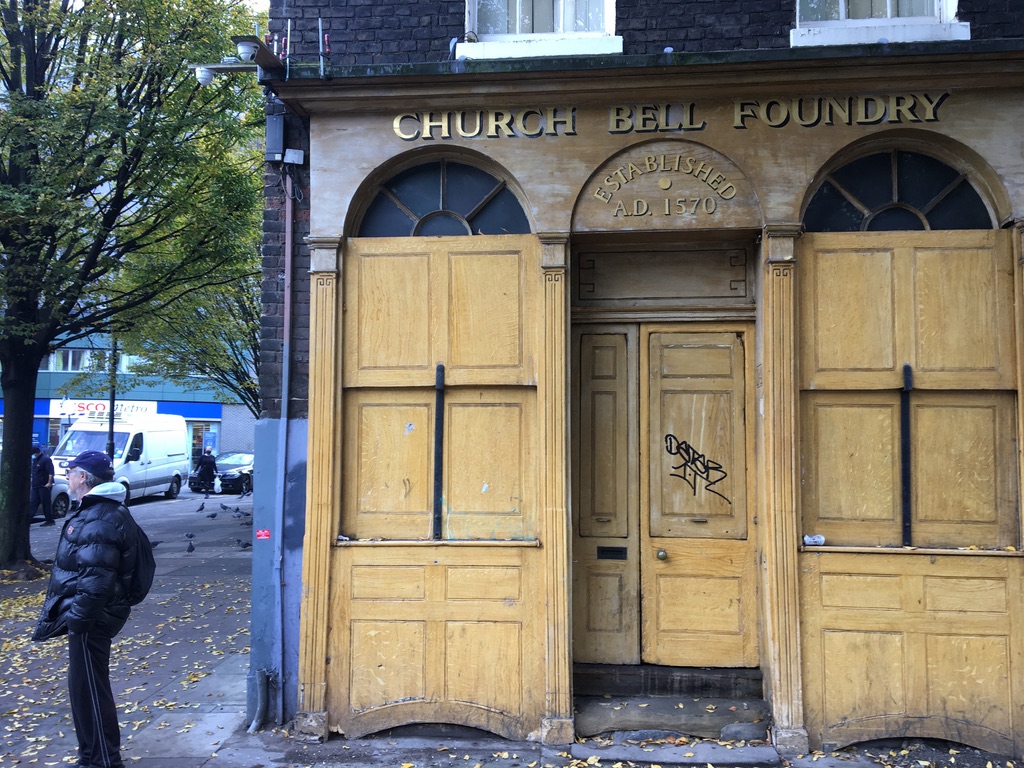
And – stop press! – there’s even a chance the Whitechapel Bell Foundry (today’s picture) might survive. The foundry, established in 1570, manufactured the Liberty Bell and recast Westminster’s Big Ben.
Then, in 2017, the present 17th century building shut up shop to make way for a luxury hotel development that would incorporate it. But now there’s an alternative plan to re-open it as a bell foundry, with a government inquiry set to make a recommendation. Ding-dong to that!
 Idle Thoughts on London Walks
Great news about Whitechapel Bell Foundry. Another gem about London. Thank you Harvey.
David bought my treasured leather jacket in Brick Lane. We used to go there for hot salt beef sandwiches.
Patricia/Trixie
LikeLike
I think the foundry inquiry was last month, so no doubt they’ll eventually get round to a ruling. The awful Jenrick has to decide, so all may hang on a bung to the Tory party!
LikeLike