ON THIS week’s Hancock’s Half Hour, the health secretary explained that if you go for a long lockdown walk and end up seven miles from home “that is OK but you should stay local”. All clear now?
His intervention helpfully absolved Prime Minister Boris Johnson of scurrilous accusations that he broke the latest Covid restrictions by cycling from Downing Street to the Olympic Park, a 14-mile round trip.
It also came to a relief to me, concerned as I was that a recent round trip, six-mile pilgrimage to Deptford might have stretched the boundaries of some obscure sub-clause of the new 100-page instructions.
As officials struggled to define what constitutes a substantial walk, one minister underlined the gravity of the situation by saying we were facing another “Scotch egg moment”.
However, the Met Police chief, Dame Cressida Dick, offered further comfort when she clarified that “local” was a relative term.
Now that these procedural ambiguities have been resolved, I would urge all Londoners to get on your bikes or, like me, into your walking shoes to explore one of the most historic corners of their historic city. Just don’t all go at once.
In primary school, a couple of teachers who were local history buffs would help to reveal this cornucopia on our doorsteps and the characters who had once populated it: Peter the Great, the murdered playright Christopher Marlowe, the 17th century diarist John Evelyn, the Dutchman Gringling Gibbon, whose lost carvings at Deptford Church were said to have been so delicate that they rustled in the breeze.
It’s where Queen Elizabeth I knighted Francis Drake on the moored Golden Hind and where Captain Cook set out on his fateful third voyage aboard the Resolution.
The Deptford dockyard, founded in 1513 by Henry VIII, was once the largest naval dockyard in the world and continued turning out warships for 350 years. The maritime connection was maintained until 2000, when the last of the commercial docks at Convoys Wharf closed.
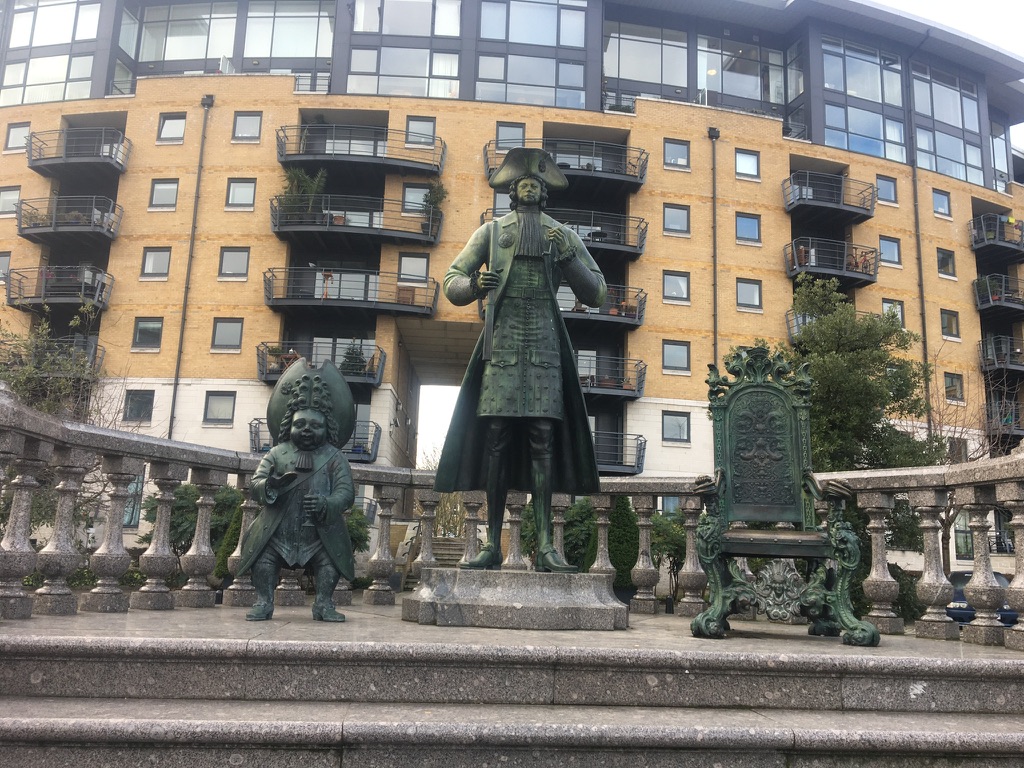
This illustrious history survives via a number of quirky memorials: a stranded anchor at the top of Deptford High Street, and a statue of the Russian czar Peter and one of his dwarves – apparently he collected them – at the mouth of Deptford Creek.
A gift from the people of Russia (today’s picture), the bronze of the pinheaded Peter and his short companion has been described as the strangest sculptures in London.
They told us at school that the czar worked anonymously in the Deptford dockyard. In fact, he came over on an official if anonymous trip in 1698 to get some dockyard ideas for St Petersburg, arriving with four chamberlains, three interpreters, two clocksmiths, a cook, a priest, six trumpeters, 70 soldiers, four dwarves and a monkey.
From the 19th century and into the 20th, Deptford underwent a steady decline and isolation, although the docks continued to provide work for many of the locals. At around the time the borough was subsumed into its blander neighbour, Lewisham, in 1965, a survey in the local paper found that a majority of Deptford women had never left the neighbourhood.
It’s still got a lively high street market, at least it was the other day when the Caribbean shops were stacking up the yams and peppers and the Kurdish fishmongers were hosing down their suspiciously exotic fish.
Deptford’s been gentrified-ish but not enough to spoil your visit. St Paul’s Church and the churchyard are worth a look, or at least would be if they hadn’t padlocked the bloody gates!
There was a quixotic plan at one time to build a cruise liner terminal next to Peter’s statue at the head of the creek. The Greater London Authority decided in 2005 that “a cruise liner terminal at the site was not considered to be appropriate at that time”. At least the planners get some things right.
 Idle Thoughts on London Walks
Please form a socially distanced queue to enter Deptford armed with a locking picking implement for the churchyard gates. Fascinating Harvey. Thank you for bringing London’s history to life.
LikeLike